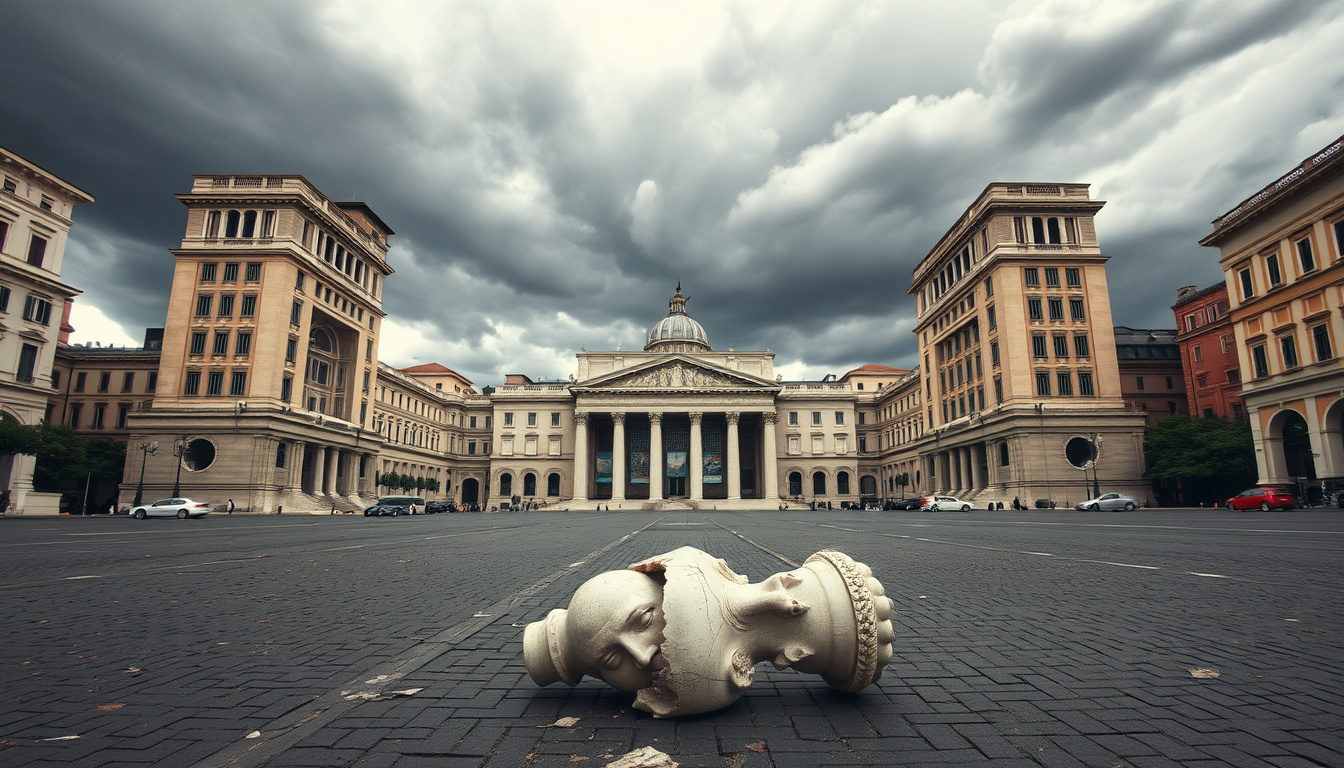
Few figures in modern history provoke as much curiosity as Benito Mussolini. The man who invented fascism, formed a brutal alliance with Hitler, and built a personality cult around himself remains a study in ambition, cruelty, and failure. This article traces his life from the village of Predappio to the Lake Como execution wall, with a particular focus on his regime’s social policies—including the persecution of LGBTQ people—and the international shockwaves that followed his death.
Born: July 29, 1883 ·
Died: April 28, 1945 ·
Position: Prime Minister of Italy (1922–1943) ·
Known for: Founding fascism ·
Execution method: Shot by partisans ·
Regime duration: 21 years
Quick snapshot
- Mussolini founded the Italian Fascist movement in 1919 (USHMM (Holocaust museum))
- He ruled as dictator from 1925 to 1943 (USHMM) (USHMM (Holocaust museum))
- Executed on April 28, 1945 by Italian partisans (USHMM) (USHMM (Holocaust museum))
- Exact last words of Mussolini remain disputed
- Whether Hitler’s suicide was directly triggered by Mussolini’s death
- Precise number of people killed under his regime
- 1883: Born in Predappio
- 1922: March on Rome, becomes PM
- 1945: Executed by partisans
- Historical reassessment of fascist social policies continues
- Modern Italy still debates Mussolini’s legacy
Eight facts about Mussolini’s life, one pattern: his trajectory from radical socialist to absolute dictator to executed war criminal.
| Label | Value |
|---|---|
| Full name | Benito Amilcare Andrea Mussolini |
| Born | July 29, 1883, Predappio, Italy |
| Died | April 28, 1945, Giulino di Mezzegra, Italy |
| Cause of death | Execution by firing squad |
| Political party | National Fascist Party |
| Spouse | Rachele Mussolini |
| Children | 5 (including Edda, Romano, and others) |
| Years in power | 1922–1943 |
What was Mussolini famous for?
Founding fascism and dictatorship
- Mussolini founded the Fasci Italiani di Combattimento in 1919, which became the National Fascist Party (National Geographic (history publication)).
- He became Prime Minister in October 1922 after the March on Rome (National Geographic).
- By 1925 he had ended democracy and established a personal dictatorship (Britannica).
Alliance with Nazi Germany
- Mussolini and Hitler met for the first time in 1934 (Britannica).
- The Pact of Steel in 1939 solidified the military alliance between Italy and Germany (Britannica).
- Italy entered World War II in 1940, anxious to claim territories as Hitler advanced (Britannica).
Downfall and execution
- Mussolini was removed from power on July 25, 1943 and placed under arrest (National Geographic).
- He was rescued by German commandos and led a puppet state in northern Italy (National Geographic).
- On April 28, 1945, communist partisans executed him along with his mistress Clara Petacci (Britannica (encyclopedia)).
The implication: Mussolini’s trajectory from revolutionary to dictator to corpse shaped the template for 20th-century strongmen.
How did Mussolini rise to power?
Early political career
- Mussolini was a socialist activist before World War I, editing the party newspaper Avanti! (Britannica).
- He broke with the socialists over support for the war and was expelled from the party.
- In 1919 he founded the Fasci Italiani di Combattimento, a nationalist paramilitary group (USHMM).
March on Rome
- In October 1922, thousands of Blackshirts marched on Rome.
- King Victor Emmanuel III, fearing civil war, appointed Mussolini Prime Minister (National Geographic).
- The march was more a theatrical demonstration than a military coup, but it worked.
Consolidation of power
- Mussolini gradually dismantled democratic institutions: bans on opposition parties, censorship, secret police (Britannica).
- By 1925 he declared himself Il Duce, the supreme leader (USHMM).
- He created a cult of personality with propaganda, mass rallies, and control of education (National Geographic).
Mussolini’s rise was enabled by a weak monarchy and a fearful elite who thought they could control him. Instead, he controlled them—and within three years, Italian democracy was dead.
The implication: Mussolini exploited institutional weakness to entrench absolute power.
What did Mussolini think of LGBTQ?
Laws against homosexuality
- Mussolini’s regime introduced anti-homosexuality laws in the 1930s, though consensual same-sex relations were not explicitly outlawed by statute (Prospect Magazine (cultural analysis)).
- Instead, the regime used administrative measures—police surveillance, internal exile, and imprisonment—to target gay men (Prospect).
- Fascist propaganda portrayed homosexuality as a degenerate foreign import incompatible with the ideal of virile masculinity (BBC News (public broadcaster)).
Persecution under fascism
- Homosexual men were arrested and sent to internal exile, often on remote islands like San Domino (Prospect).
- Mussolini viewed homosexuality as an imported vice and refused to officially recognize it, which made persecution arbitrary and inconsistent (Prospect).
- The regime’s “racial laws” of 1938 extended discrimination to Jews and, by implication, to LGBTQ people (USHMM).
Comparison to Nazi Germany
- Nazi persecution of homosexuals was far more systematic, with thousands sent to concentration camps.
- Italian fascist persecution was less organized but still severe: hundreds of men were exiled, and the atmosphere of fear was pervasive (BBC).
- The BBC notes that fascism’s core ideology of strength and masculinity made homosexuality ideologically unacceptable (BBC).
Mussolini’s LGBTQ policies are often overlooked in standard biographies, but they reveal a key dimension of fascist control: the regime policed not just politics and economics, but also personal identity. For modern readers, this is a reminder that authoritarianism targets private life as much as public dissent.
The implication: Mussolini’s social engineering extended beyond politics into the most intimate aspects of life.
Why was Mussolini disliked?
Suppression of opposition
- Mussolini banned all political parties except the Fascist Party, created a secret police (OVRA), and arrested thousands of opponents (Britannica).
- Socialists, communists, and trade unionists were beaten, imprisoned, or killed (Britannica).
- Free press was abolished; journalists faced imprisonment for criticizing the regime.
Economic failures
- Mussolini’s policy of autarky (economic self-sufficiency) failed to modernize Italy’s economy (Britannica).
- Agricultural production stagnated, and industrial growth was weaker than in other European countries.
- The “Battle for Grain” increased wheat output but at the cost of livestock and other crops.
Military incompetence
- Italy’s invasion of Ethiopia (1935–1936) was brutal but costly, using poison gas against civilians (National Geographic).
- Intervention in the Spanish Civil War drained resources.
- By 1943, Italy’s military was defeated on multiple fronts, making the country dependent on Germany (Britannica).
The implication: Mussolini’s failures eroded the very support that once carried him to power.
Who actually shot Mussolini?
Capture by partisans
- On April 27, 1945, Mussolini attempted to flee to Switzerland disguised as a German soldier (USHMM).
- He was captured by communist partisans of the 52nd Garibaldi Brigade near Lake Como (USHMM).
- His mistress Clara Petacci refused to leave him and was captured as well (USHMM).
Execution on April 28, 1945
- Partisans executed Mussolini and Petacci the next day in the village of Giulino di Mezzegra (Britannica).
- The official version states that communist partisan leader Walter Audisio pulled the trigger, acting on orders from the National Liberation Committee (Britannica).
- Some accounts suggest other partisans were involved, including a man named Luigi Longo (Britannica).
Controversy over the exact shooter
- For decades, the identity of the shooter was disputed. Some historians argue that a partisan named Aldo Lampredi may have been the executioner (Britannica).
- Audisio’s account was officially accepted, but alternative versions persist (Britannica).
- The bodies were later taken to Milan and hung upside down at a gas station for public display.
The identity of Mussolini’s executioner matters because it shaped post-war Italian politics. The Communist Party used the execution to claim legitimacy as the force that defeated fascism, while anti-communists saw it as a political killing.
The implication: The contested identity of the shooter reflects the ongoing political struggle over Mussolini’s legacy.
What was Hitler’s reaction to Mussolini’s death?
Hitler’s knowledge of the execution
- Hitler learned of Mussolini’s death on April 28, 1945, in his bunker in Berlin (British).
- According to accounts, Hitler reportedly expressed horror and despair at the news (British).
- Despite their personal tensions—the two men reportedly did not particularly like each other (National WWII Museum (institutional history))—the alliance was existential for both.
Impact on Hitler’s own suicide
- Some historians believe Mussolini’s execution hastened Hitler’s decision to kill himself (National WWII Museum).
- On April 30, 1945, just two days later, Hitler shot himself in the Führerbunker (National WWII Museum).
- Hitler had previously spoken of his fear of being captured alive and humiliated, a fate he saw Mussolini suffer (National WWII Museum).
Historical accounts
- The National WWII Museum notes that Mussolini’s death was seen by The New York Times as “a fitting end to a wretched life” (National WWII Museum).
- Winston Churchill, who had once called Mussolini “a great man” (later retracted), remained silent on the execution.
- The sequence of events—Mussolini dead on the 28th, Hitler dead on the 30th—marked the definitive collapse of the Axis alliance.
The implication: Mussolini’s death removed Hitler’s last major ally and accelerated the Nazi regime’s collapse.
Timeline of key events
- 1883 – Born in Predappio, Italy
- 1919 – Founds the Fasci Italiani di Combattimento
- 1922 – March on Rome; becomes Prime Minister
- 1925 – Declares himself dictator (Il Duce)
- 1938 – Enacts racial laws targeting Jews and LGBTQ people
- 1940 – Italy enters World War II as ally of Germany
- 1943 – Overthrown by Grand Council of Fascism; arrested
- 1945 – Executed by Italian partisans
What we know and what remains unclear
Confirmed facts
- Mussolini executed by partisans on April 28, 1945 (USHMM)
- He was a fascist dictator who ruled from 1922 to 1943 (Britannica)
- He allied with Nazi Germany through the Pact of Steel (Britannica)
- He suppressed political opposition and banned other parties (Britannica)
- His regime persecuted LGBTQ people through exile and imprisonment (Prospect)
What’s unclear
- Exact last words of Mussolini
- Whether Hitler’s suicide was directly triggered by Mussolini’s death
- Precise number of people killed under his regime
- Which partisan actually fired the fatal shot
Perspectives on Mussolini
“It is better to live one day as a lion than 100 years as a sheep.”
Benito Mussolini, in a speech
“Mussolini was a great man.”
Winston Churchill, later retracted
“A fitting end to a wretched life.”
The New York Times, reporting on Mussolini’s death, as cited by the National WWII Museum
“Fascism is a virile regime.”
Fascist propaganda, quoted by BBC News
Mussolini’s life ended in the dirt of a Lake Como village, his body hung upside down for a mob to jeer. The man who promised to make Italy a great power left it broken, occupied, and traumatized. For modern Italy, the legacy of fascism remains a live debate: whether to confront the past honestly or to sanitize it. The choice is clear: acknowledge the full scope of Mussolini’s crimes—including his persecution of LGBTQ people—or risk repeating the same patterns under a different name.
en.wikipedia.org, library.macewan.ca, youtube.com, link.springer.com, reddit.com, etd.ceu.edu
Frequently asked questions
What was Mussolini’s childhood like?
Mussolini was born into a working-class family; his father was a blacksmith and socialist activist, his mother a schoolteacher. He was a rebellious child, often in trouble at school.
How many children did Mussolini have?
Mussolini had five children with his wife Rachele: Edda, Vittorio, Bruno, Romano, and Anna Maria. He also had a son, Benito Albino, with his first wife Ida Dalser.
What is Mussolini’s legacy in modern Italy?
Mussolini’s legacy is deeply contested. Some far-right groups still celebrate him, while mainstream Italian culture condemns his regime. Monuments and street names have been removed in many cities, but the debate over his historical role continues.
Did Mussolini have any positive achievements?
Some historians note that Mussolini built infrastructure, drained marshes, and made trains run on time—but these achievements were used to prop up a dictatorship. The human cost of repression far outweighs any material improvements.
Was Mussolini educated?
Mussolini trained as a teacher and was an avid reader. He was self-taught in many subjects and worked as a journalist before entering politics.
How did Mussolini’s body end up in Milan?
After his execution, partisans brought Mussolini’s body to Milan and hung it upside down at a gas station on Piazzale Loreto. The display was a public humiliation and a warning to remaining fascists.
What happened to Mussolini’s family after his death?
His widow Rachele was arrested briefly, then released. His children scattered: Edda fled to Switzerland, Romano became a jazz pianist, and the others lived quietly in Italy. The family never regained political influence.
Related stories




Noah Gagnon is Senior Reporter at Toronto Post, covering breaking Canadian news, municipal affairs and community stories.