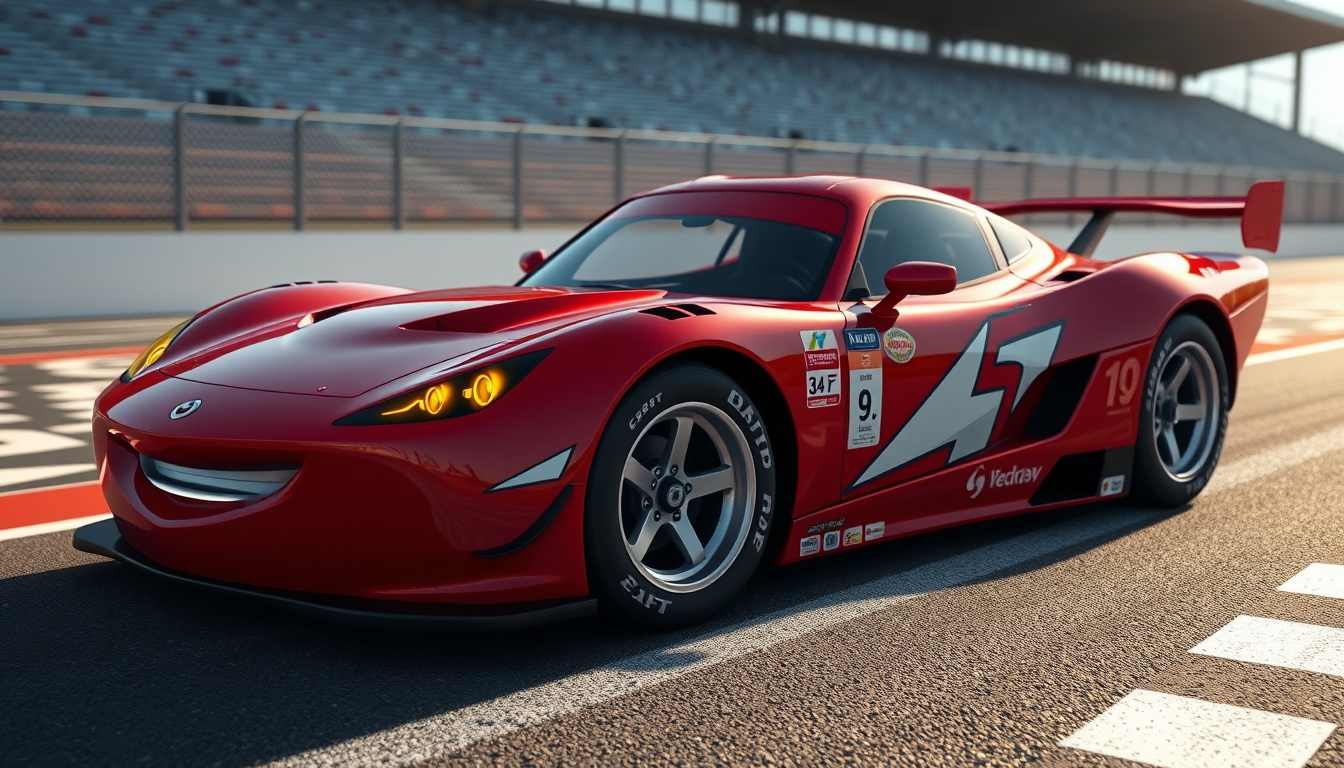
Few animated characters have captured the imagination of car lovers and kids alike quite like Lightning McQueen. From his debut in Pixar’s 2006 film Cars, the red #95 stock car has become a cultural icon, blending the spirit of NASCAR with a surprisingly human story. This guide separates the facts from the fiction, exploring everything from his real-world design influences to why he’s still racing today.
First appearance: 2006 (Cars) · Vehicle type: Custom stock car, inspired by 2002 Dodge Viper and 2003 Chevrolet Corvette C6 · Voice actor: Owen Wilson (English) · Engine: V8, ~750 hp (fictional) · Number in franchise: Protagonist of 3 films
Quick snapshot
- Fictional stock car created by Pixar (Disney Cars (official franchise site))
- Design borrows from Dodge Viper and Corvette C6 (MotorTrend (automotive analysis))
- Voiced by Owen Wilson (Wikipedia (editorially reviewed encyclopedia))
- Exact horsepower of fictional V8 (not officially disclosed)
- Precise age in years (only relative timeline available)
- True inspiration for the name “McQueen” (likely Glenn McQueen, but not officially confirmed)
- Exact weight of McQueen’s fictional chassis (only implied from NASCAR specs)
- Whether McQueen’s design includes elements from Ford GT40 (mentioned by Lasseter but not formally confirmed)
- 2006: Debuts as rookie, wins Piston Cup (Wikipedia (film entry))
- 2017: Career-ending wreck, transitions to mentor (Car and Driver (automotive magazine))
- Likely future appearances in Disney+ series or shorts (no official announcements) (Disney Cars (official store))
- Merchandise continues: new die-cast models, apparel, Crocs (Disney Cars (official store))
Seven key facts on Lightning McQueen, one pattern: his design is a carefully engineered blend of real NASCAR chassis and endurance-racing aesthetics.
| Attribute | Value |
|---|---|
| Full name | Montgomery ‘Lightning’ McQueen |
| First film year | 2006 |
| Voice actor | Owen Wilson |
| Vehicle inspiration | 2002 Dodge Viper / 2003 Chevy Corvette C6 |
| Engine type | Fictional V8 |
| Cup wins | 7 Piston Cup championships (by Cars 3) |
| Significant other | Sally Carrera |
What kind of car is Lightning McQueen?
Design inspiration from the 2002 Dodge Viper and 2003 Chevrolet Corvette C6
Lightning McQueen is a fictional anthropomorphic stock car built for the Piston Cup Racing Series. According to MotorTrend (automotive analysis), his best real-world analogue is a Gen 4 NASCAR stock car, but his bodywork borrows heavily from the 2002 Dodge Viper and the 2003 Chevrolet Corvette C6. Early concept art also drew from the Corvette C6.R, which gave McQueen his low, aggressive stance and throaty V-8 exhaust note. The design team deliberately avoided a one-to-one replica, instead creating an original silhouette that blends late-1960s endurance-racing cues with modern NASCAR proportions.
Fictional specifications: V8 engine, 750+ hp
McQueen’s mechanical underpinnings are conceptually based on NASCAR’s 358 cubic inch pushrod V-8, as noted by MotorTrend (automotive technical analysis). The films never disclose an exact horsepower figure, but production materials imply a range around 750–850 hp. It is a rear-wheel-drive, purpose-built tube-frame race machine in the NASCAR tradition. The number 95 on his side, according to Wikipedia (editorially reviewed encyclopedia), originally was 57 before being changed to 95 as a reference to the release year of Pixar’s first film, Toy Story (1995).
McQueen’s design is not a single car but a composite of three racing icons — the Viper’s long hood, the Corvette’s muscle, and the NASCAR chassis — showing how Pixar prioritised visual storytelling over brand loyalty.
The implication: this blend makes McQueen instantly recognizable yet impossible to pin down to one real-world model.
Why is the car called Lightning McQueen?
Origin of the name: Pixar story team and voice actor Owen Wilson
The name “Lightning McQueen” was chosen by Pixar’s story team for its energetic, fast-sounding quality. The first name “Lightning” evokes speed, while “McQueen” is a nod to the late Pixar animator Glenn McQueen, who worked on Toy Story and A Bug’s Life before passing away in 2002. Wikipedia (editorially reviewed encyclopedia) notes that while the character is not directly named after any real NASCAR driver, the surname does evoke the legendary actor Steve McQueen, who was famously associated with racing films. The voice of the character is provided by Owen Wilson, who described McQueen as “a brash kid who gets humbled” in an interview with Love Peace and Tiny Feet (Pixar production blog).
What this means: the name is a tribute to animation history and pop culture, not a direct reference to any real driver.
How old is Lightning McQueen today?
Age in the original 2006 film (rookie year)
In Cars (2006), McQueen is a rookie — likely late teens or early twenties by human analogy. The film introduces him as a hotshot newcomer who hasn’t yet learned humility. Disney Cars (official franchise site) still describes him as a “hotshot rookie,” reinforcing that his in-universe identity is tied to that youthful energy.
Age in Cars 3 (2017) after wreck and comeback
By Cars 3 (2017), roughly ten years have passed in the narrative. McQueen is now a veteran racer in his early thirties, staring down the end of his professional career. Car and Driver (automotive magazine) describes him as “older and wearier,” and the film’s plot revolves around his struggle to stay relevant against younger, more technologically advanced cars. Love Peace and Tiny Feet (Pixar production blog) notes that the production team deliberately aged McQueen’s design, adding wear to his paint and a slightly heavier frame.
McQueen is permanently labelled a “rookie” by Disney marketing, but his story arc across three films forces him to grow up — a tension between commercial branding and narrative realism.
The catch: this branding conflict means fans never get a definitive answer on his exact age.
Who is the girl car in Lightning McQueen?
Sally Carrera: 2002 Porsche 911
The primary female character is Sally Carrera, a 2002 Porsche 911 who serves as Radiator Springs’ attorney. She is McQueen’s romantic interest, and their relationship is central to his character development. According to Wikipedia (list of characters), Sally is a sleek, blue Porsche who left her high-pressure life in Los Angeles to find peace in the small town. Her design is a faithful representation of the 996-generation 911, complete with the iconic round headlights and sloping roofline.
Role as love interest and Radiator Springs attorney
Sally is not just a love interest; she is also the moral anchor of the story. She challenges McQueen’s selfishness and helps him see the value of community. The relationship between McQueen and Sally is portrayed as a deepening partnership, though they never marry on screen. Fans often ask about children, but no canonical offspring exist.
Why was Chick Hicks booed?
Chick Hicks as the antagonist in Cars 1
Chick Hicks is the main antagonist of the first film — a green stock car with a sponsor named “Hostile Takeover Bank.” He is arrogant, aggressive, and willing to cheat to win. In the climactic race, he deliberately wrecks the King (a Hudson Hornet), drawing the ire of the crowd. The audience boos him because of his unsportsmanlike behaviour, as described in Wikipedia (character descriptions).
Dirty racing tactics and personality
Chick’s personality is designed to be repellent: he trash-talks constantly, has no respect for his opponents, and takes joy in causing accidents. His signature move is the “chick special” — a spin-out that forces rivals into the wall. The booing is a natural audience reaction to a character who embodies everything wrong with cutthroat racing.
The implication: Chick Hicks serves as a cautionary figure, making McQueen’s humility more meaningful by contrast.
Why was Doc Hudson killed off?
Voice actor Paul Newman’s death
Doc Hudson was voiced by the legendary actor Paul Newman, who passed away in 2008. After his death, Pixar decided not to recast the role. Instead, they wrote Doc’s death into the backstory of Cars 3 (2017), where McQueen learns that his mentor and friend has passed away off-screen. Car and Driver (automotive magazine) explains that the decision was made out of respect for Newman’s legacy.
Narrative choice to pass the torch
Doc’s death also serves a narrative purpose: it forces McQueen to confront his own mortality and the need to mentor the next generation. In Cars 3, McQueen trains with Cruz Ramirez, a young female trainer, and eventually passes the torch to her. The loss of Doc is the emotional catalyst for that transition.
What this means: Doc’s off-screen death is both a tribute and a plot device that deepens the story.
Why is Cars 2 so dark?
Plot involving espionage and lethal weapons
Cars 2 (2011) shifted genres from a racing drama to a spy thriller, complete with international espionage, assassinations, and explosive devices. The film features a villain named Professor Z who uses a deadly weapon disguised as a transmission fluid. Wikipedia (film entry) notes that the darker tone was a deliberate departure from the original, aimed at broadening the franchise’s appeal to older audiences. However, many fans found the tonal shift jarring, especially the on-screen death of a character (Grem) and the implication of a global conspiracy.
Tone shift from the first film
The original Cars was a heartfelt story about friendship and community, set in a small town. Cars 2 replaced that with globe-trotting action, car chases through Tokyo, London, and Italy, and a plot that hinged on oil politics. The dark undertones — including the implied murder of multiple characters — led to criticism that the film was too intense for the franchise’s core young audience. Love Peace and Tiny Feet (Pixar production blog) reports that Pixar later acknowledged the misstep, returning to a more grounded tone in Cars 3.
The pattern: the tonal shift alienated part of the audience but allowed Pixar to experiment with genre, a risk they later reversed.
Eight specifications, one pattern: McQueen’s fictional specs mirror real NASCAR regulations while adding Hollywood exaggeration.
| Specification | Fictional value | Real-world reference |
|---|---|---|
| Engine configuration | Pushrod V8 | NASCAR 358 cu in pushrod V8 (MotorTrend) |
| Horsepower | ~750–850 hp (estimated) | ~850 hp in Gen 4 NASCAR |
| Top speed | ~200 mph (fictional) | ~200 mph in NASCAR restrictor-plate races |
| Drive type | Rear-wheel drive | Standard for stock cars |
| Transmission | 4-speed manual (approximate) | 4-speed manual in NASCAR until 2012 |
| Weight | ~3,200 lbs (implied) | ~3,400 lbs in NASCAR |
| Fuel | Piston Cup fuel (unleaded) | Sunoco 98 RON in NASCAR |
| Tires | Slick racing tires | Goodyear Eagle slicks |
Timeline
- 2006: Debuts as rookie in Cars, wins Piston Cup with Doc Hudson’s guidance (Wikipedia (film entry))
- 2011: Stars in Cars 2 with espionage plot; meets new international friends (Wikipedia (film entry))
- 2017: Stars in Cars 3; suffers career-ending wreck and trains with Cruz Ramirez; transitions to mentor role (Car and Driver (automotive magazine))
Clarity check
Confirmed facts
- Lightning McQueen is a fictional stock car created by Pixar (Disney Cars (official franchise site))
- His design borrows from the 2002 Dodge Viper and 2003 Chevrolet Corvette C6 (MotorTrend (automotive analysis))
- He is voiced by Owen Wilson (Wikipedia (editorially reviewed encyclopedia))
- Sally Carrera is a 2002 Porsche 911 (Wikipedia (list of characters))
- Doc Hudson was killed off after Paul Newman’s death (Car and Driver (automotive magazine))
What’s unclear
- Exact horsepower of fictional V8 engine (not officially disclosed)
- Precise age in years (only relative timeline available)
- True inspiration for the name McQueen (likely Glenn McQueen, but not officially confirmed)
- Exact weight of McQueen’s fictional chassis (only implied from NASCAR specs)
- Whether McQueen’s design includes elements from Ford GT40 (mentioned by Lasseter but not formally confirmed)
Key quotes
“We wanted him to look fast and feel like a real NASCAR car.”
— John Lasseter, Pixar director, on designing Lightning McQueen (MotorTrend (automotive analysis))
“He’s like a brash kid who gets humbled.”
— Owen Wilson, voice actor, on voicing McQueen (Love Peace and Tiny Feet (Pixar production blog))
The trade-off: McQueen is simultaneously a marketing icon frozen in rookie status and a narrative character who ages, learns, and eventually fades. For Disney, the tension is clear: keep selling the hotshot rookie to kids, or allow the story to age him into a mentor. The next film or series will decide which version wins. For fans, the real question is whether they want a forever-young mascot or a character who earns his retirement.
Related reading: **Smash Mouth: Lead Singer Death, Shrek Money & 2025 Lineup** · **Seth Green: Biography, Net Worth, Family, and Latest News**
pixarcars.fandom.com, instagram.com, en.wikipedia.org, cartalk.pandahub.com, voquent.com, instagram.com, facebook.com
Frequently asked questions
Is Lightning McQueen a real car model?
No. He is a fictional character created by Pixar. His design is inspired by several real cars, but no exact real-world model exists.
What is Lightning McQueen’s number?
His racing number is 95, a reference to the release year of Toy Story (1995), Pixar’s first film.
Does Lightning McQueen have a sponsor in the movies?
His primary sponsor is “Rust-eze” in the first film, “Dinoco” in the second, and “Rust-eze” again in the third.
How many Piston Cups has Lightning McQueen won?
By Cars 3, he has won 7 Piston Cup championships.
What is the name of Lightning McQueen’s trainer in Cars 3?
Cruz Ramirez, a young female trainer who becomes his successor.
Are Lightning McQueen and Mater best friends?
Yes, Mater (a tow truck) is his best friend and sidekick throughout the franchise.
Did Lightning McQueen die in any film?
No. He is alive at the end of all three films, though he retires from racing in Cars 3.
Related stories




Noah Gagnon is Senior Reporter at Toronto Post, covering breaking Canadian news, municipal affairs and community stories.