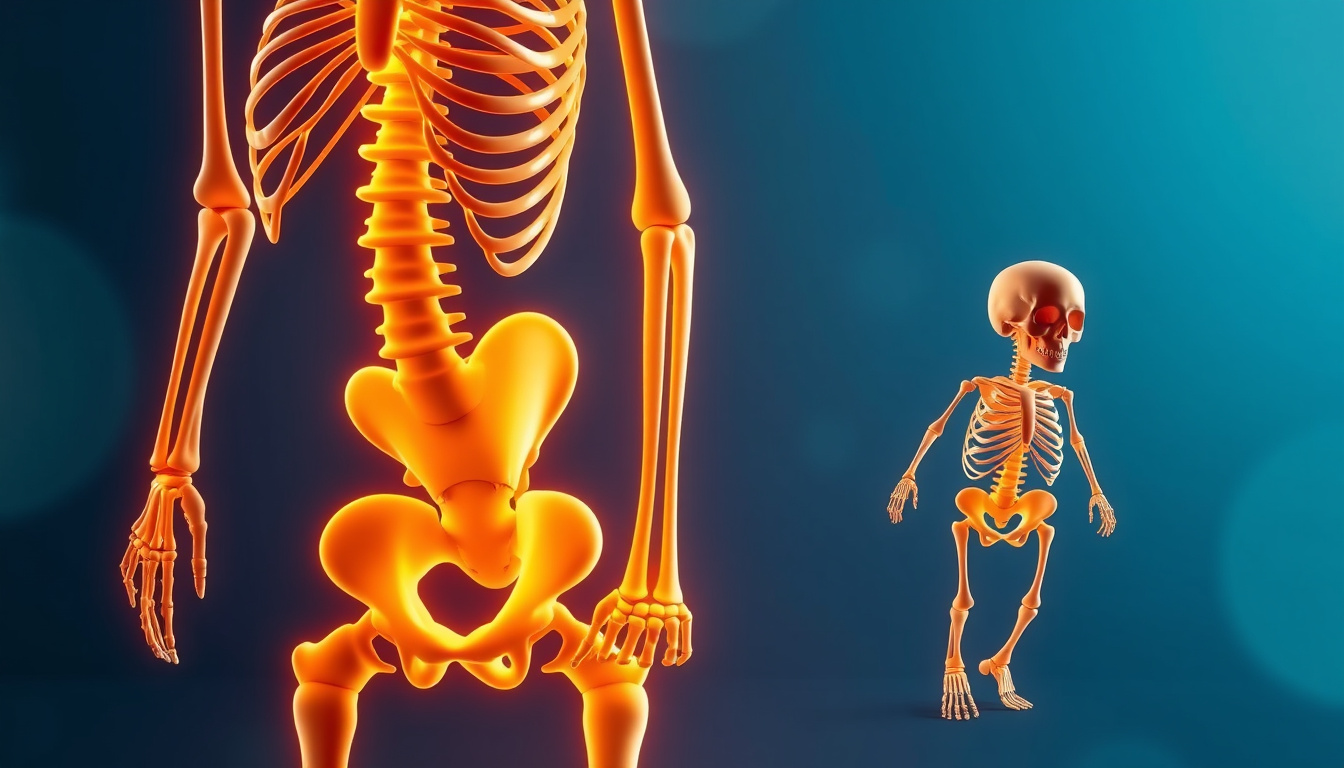
You probably absorbed the number 206 somewhere along the way — filed it in the back of your brain with other school-day trivia. What fewer people realize is that this number is only true for adults. Babies enter the world with considerably more bones, and the count shrinks through childhood as dozens of small bones gradually fuse together. The reason why is rooted in how human skeletons develop from birth through early adulthood.
Adults: 206–213 bones · Newborns: ~270 bones · Axial skeleton: 80 bones · Appendicular skeleton: 126 bones
Quick snapshot
- Adults have between 206 and 213 bones (Cleveland Clinic)
- Newborns arrive with roughly 270 bones (Cleveland Clinic)
- Bones comprise approximately 15% of adult body weight (Healthline)
- Exact count varies by individual due to sesamoid and sutural bone differences
- Precise age-by-age breakdown for children remains loosely documented
- Bone fusion begins in infancy and continues through late adolescence (Healthline)
- By early adulthood, the fusing process has stopped (Healthline)
- Adult bone count remains stable unless surgical addition of plates, pins, or artificial joints occurs
- Bones continue remodeling throughout life via osteoblast and osteoclast activity
The following table consolidates the key bone count figures across life stages and skeleton divisions.
| Bone count category | Number |
|---|---|
| Standard adult count | 206 |
| Newborn count | ~270 |
| Possible adult maximum | 213 |
| Axial bones | 80 |
| Appendicular bones | 126 |
How Many Bones Are in the Human Body?
The standard answer is 206 bones for a fully developed adult. This count comes from anatomical textbooks and anatomical reference standards used in medicine and research worldwide.
Anatomists divide the adult skeleton into two main groups. The axial skeleton — the body’s central vertical axis — consists of 80 bones, including the skull, vertebral column, and rib cage. The appendicular skeleton, comprising the limbs and their attachments, accounts for the remaining 126 bones (Healthline).
206 is the textbook number. In reality, some adults have up to 213 bones because of individual variations — specifically, extra sesamoid bones (small bones embedded in tendons) and sutural bones in the skull. These extra bones are not universal, which explains the range.
Adult bone count
An adult bone is a mature structure composed of two regions: the diaphysis, the long shaft, and the metaphysis, the widened portion near each end (Nebraska Orthopaedic Center). Once bone growth plates close during late adolescence, no new bones are added — the count is fixed.
Axial vs. appendicular
The axial skeleton’s 80 bones protect vital organs: the skull shields the brain, the rib cage surrounds the heart and lungs, and the vertebral column houses the spinal cord. The appendicular skeleton’s 126 bones enable movement and locomotion — arms, legs, hands, and feet.
Bones collectively make up about 15 percent of adult body weight, providing both structural support and metabolic functions like mineral storage and blood cell production (Healthline).
The implication: your skeleton is not just a static framework. It is a living system that remodels itself continuously throughout your entire life.
Are There 206 or 213 Bones?
Both numbers are correct — it depends on how you count. The 206 figure represents the skeletal minimum found in most adult humans. The higher count reflects individual anatomical variations that not everyone possesses.
Reasons for variation
The variation comes down to two categories of bones that are not present in every person: sesamoid bones and sutural bones.
Sesamoid bones are small, seed-shaped bones that develop within tendons, typically where tendons pass over joints. The patella (kneecap) is the largest and most consistent sesamoid bone. Smaller sesamoid bones sometimes develop in the hands and feet. These additional sesamoids can add 2 to 7 extra bones to the count.
Sesamoid and sutural bones
Sutural bones (also called wormian bones) are small, irregularly shaped bones found along the sutures — the fibrous joints between skull bones. They are most common in the lambdoid suture (back of the skull) and the squamosal suture (side of the skull). Some individuals have several; others have none.
The reason these variations exist: skeletal development is not a perfectly uniform process. Genes, nutrition during development, and individual growth patterns all influence whether these extra bones form.
What this means: if you have your skeleton meticulously counted after death, the number could fall anywhere from 206 to 213 depending on your individual anatomy.
How Many Bones in the Human Body at Birth?
Babies are born with roughly 270 bones — significantly more than adults have. This number may sound counterintuitive until you understand why newborns need more bones in the first place.
Newborn count
Approximately 60 percent of a newborn’s skeleton is composed of cartilage, a flexible connective tissue that is not bone but serves as a scaffold for future bone formation (Cleveland Clinic). Many of these cartilage structures are segmented into multiple pieces, which is why newborns have more separate skeletal elements than adults.
The high cartilage content serves a practical purpose: it makes the skeleton more flexible for passing through the birth canal and allows for rapid post-birth growth.
Fusion process
As a child grows, these many separate cartilage pieces gradually ossify — converting into bone through a process called secondary ossification. Additionally, separate bones that develop from multiple centers of ossification gradually fuse together over time (LibreTexts Biological Anthropology).
The fusion process explains how roughly 270 bones at birth become 206 in adulthood. More than 60 bones are lost from the count as separate pieces merge into unified structures.
An infant’s skeleton is not simply a smaller version of an adult skeleton. The high proportion of cartilage and the presence of growth plates at each end of long bones enable the dramatic growth spurts of childhood — something impossible with a fully fused adult skeleton.
How Do Babies Go from 300 Bones to 206?
The shift from approximately 270 (some sources cite closer to 300) bones at birth down to 206 in adulthood is not a loss in the sense of bones disappearing. It is a process of fusion — separate skeletal elements joining together into single, unified bones.
Ossification stages
Bone formation begins before birth. Most bones develop through endochondral ossification, where cartilage templates are gradually replaced by bone tissue. Some flat bones (like skull bones) develop through intramembranous ossification, where bone forms directly within connective tissue membranes.
At birth, many of these bones are still incompletely formed. The centers of ossification that will eventually create a single adult bone may still be separate cartilage structures connected by growth plates.
Common fusions
Major fusions that reduce the bone count include:
- The skull: Several separate skull bones fuse along suture lines, though full fusion may not complete until adulthood
- The vertebral column: Many separate vertebrae elements merge into individual vertebral bones
- The pelvis: Several iliac, ischial, and pubic elements fuse into the hip bones
- The sacrum: Five separate vertebrae fuse to form the sacrum
- The coccyx: Three to five vertebrae fuse to form the tailbone
Many of these fusion processes are not complete until the late teens or early twenties. The growth plates (physes) at the ends of long bones are the last structures to close, signaling the end of longitudinal bone growth.
The pattern: bone count alone does not capture the full story of skeletal development. The structural differences between child and adult bones are equally important for understanding how young skeletons function, grow, and heal.
The human body essentially over-builds its skeleton in infancy, then selectively simplifies it through fusion as growth proceeds. This approach allows for both flexible passage through the birth canal and the rapid post-birth growth that characterizes human development.
How Many Bones in the Human Body Child?
Children have more bones than adults because fusion is ongoing throughout childhood and adolescence. The exact count varies by age, but children consistently outnumber adults until late adolescence.
Age-specific counts
At age 7, children have approximately 250 bones — still well above the adult count of 206. This means roughly 44 fusion events still need to occur before skeletal maturity.
The difference between child and adult bone structure is significant beyond just count. A child’s bone contains four distinct regions: the diaphysis, metaphysis, epiphysis, and physis (growth plate) (Nebraska Orthopaedic Center). Adult bones have only two primary regions — the diaphysis and metaphysis — because the epiphyses and physes have fused.
7-year-old example
A 7-year-old’s skeleton is still highly flexible compared to an adult’s. Juvenile bone contains more Haversian canals — tiny tubes that form a network containing blood vessels — making it more flexible and better able to absorb impact without fracturing (Nebraska Orthopaedic Center). This is why greenstick fractures (partial fractures common in children) occur more easily in young skeletons.
The osteoid density of a child’s bone is also less than that of an adult, meaning children’s bones are generally lighter and less mineralized — part of why they heal faster and remodel more completely than adult bones.
The implication: pediatric and adult orthopedic care require fundamentally different approaches because of these structural differences in bone composition and healing capacity.
Major bones overview
The human body has 206 bones total, organized into two divisions: 80 axial bones (skull, spine, rib cage) and 126 appendicular bones (arms, legs, hands, feet, and their attachments). The skeleton is not divided into exactly 7 major bones as some might assume from colloquial references.
Confirmed facts
- Adults typically have 206 bones
- Newborns have roughly 270 bones
- Bones fuse throughout childhood and adolescence
- Early adulthood marks the end of bone fusion
What’s unclear
- Precise age-by-age bone counts are not well documented in mainstream sources
- Individual variation in fusion timing remains poorly characterized
Adults have between 206 and 213 bones, and these bones are divided into two main groups.
— Cleveland Clinic medical team
The adult skeleton consists of 206 bones, each developing from multiple centers of ossification.
For a parent tracking a child’s growth, the takeaway is concrete: the bone count your child has today is not the bone count they will have as an adult. The skeleton is actively remodeling itself through childhood, and understanding this process helps explain why children’s bones heal differently, why growth spurts occur, and why pediatric and adult orthopedic care require different approaches.
Related reading: Lunge exercise · Why is my poop green
Frequently asked questions
Who has 270 bones?
Newborn babies are born with approximately 270 bones. This count is higher than adults because many bones are still separate cartilage structures that will later fuse together as the child grows.
What are the 7 major bones of the body?
The human body has 206 bones total, not 7. The skeleton is organized into two divisions: 80 axial bones (skull, spine, rib cage) and 126 appendicular bones (arms, legs, hands, feet, and their attachments).
How many bones does a 7 year old have?
A 7-year-old has approximately 250 bones — still significantly more than the adult count of 206. The difference reflects ongoing bone fusion that continues throughout childhood and into late adolescence.
What is the strongest bone?
The femur (thigh bone) is the strongest bone in the human body. It is designed to withstand enormous forces during walking, running, and jumping, bearing more weight-bearing stress than any other single bone.
What is the hardest bone to heal?
The scaphoid bone in the wrist is notoriously difficult to heal due to its limited blood supply. Fractures in this bone often have poor healing outcomes and may require surgical intervention.
What age do bones stop growing?
Bones stop growing in length when the growth plates (physes) close, typically between ages 16-18 for girls and 18-21 for boys. After growth plates close, bones can no longer lengthen, though they continue remodeling throughout life.
How many bones in a male body?
Males and females have the same number of bones — 206 as a standard count, with individual variations up to 213. Some anatomical differences exist in shape and density, but the total count is identical.
How many bones in a female body?
Like males, females have 206 bones as a standard count. The female pelvis is generally wider and shallower than the male pelvis, which is an adaptation for childbirth, but this reflects shape differences, not a different number of bones.
Related stories





Catherine Roy is Editor-in-Chief at Toronto Post, overseeing editorial policy, corrections, standards and publication decisions across the newsroom.