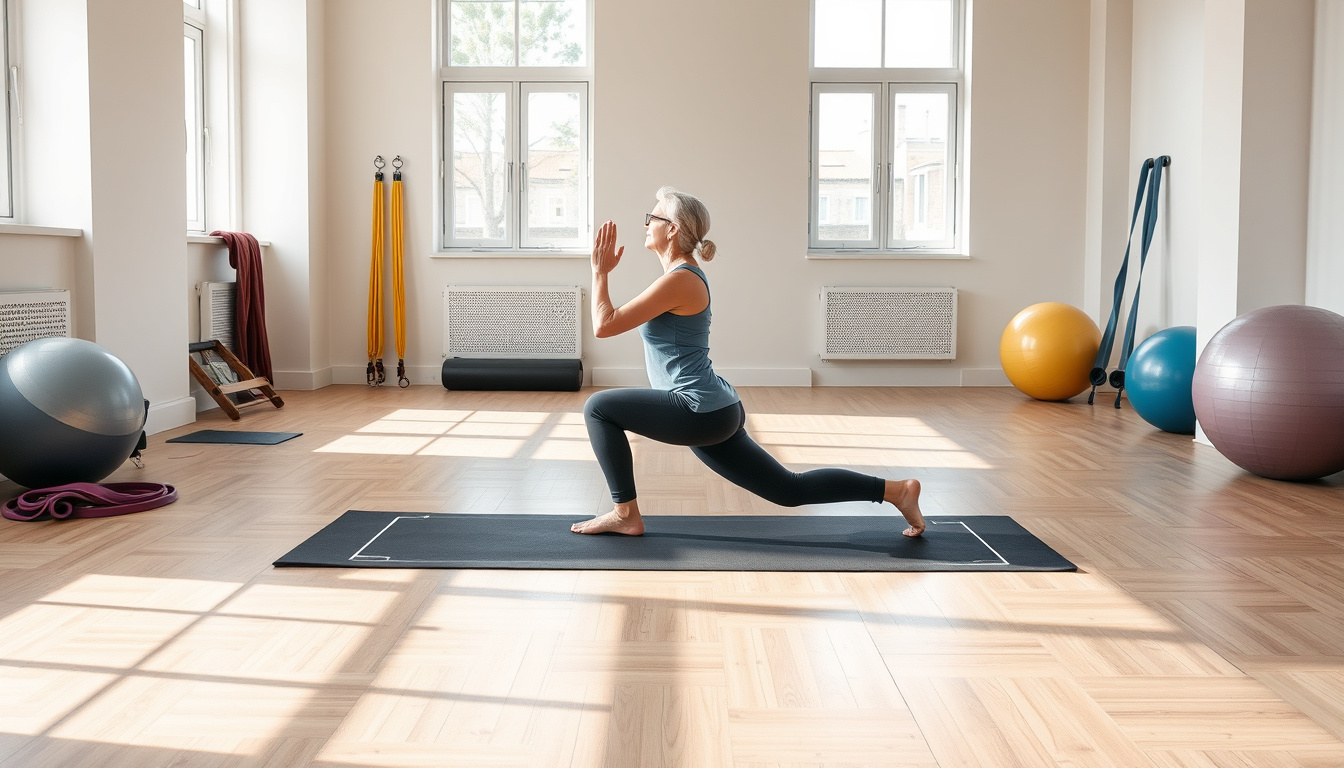
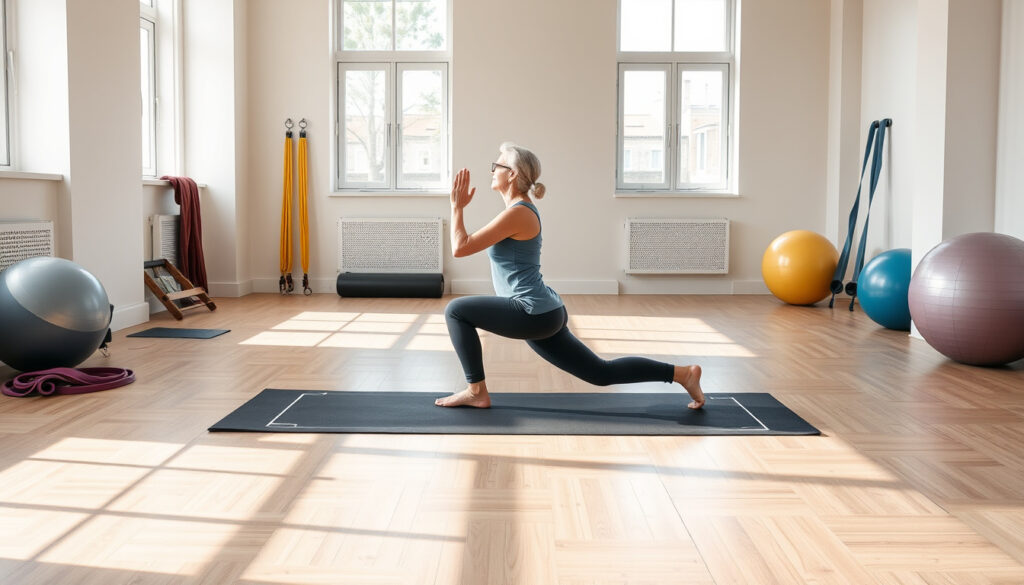
If you’ve ever struggled to get up from a low chair or felt unsteady on stairs, lunges are exactly what your body is asking for. This foundational exercise builds the single-leg strength that keeps older adults independent and confident.
Primary muscles targeted: Quadriceps and hamstrings ·
Secondary muscles: Glutes, calves, core ·
Exercise type: Unilateral bodyweight ·
Key benefits: Single-leg strength and balance ·
Common variations: Forward, reverse, walking
Quick snapshot
- Lunges target quadriceps and hamstrings (Harvard Health)
- Reverse lunges reduce knee stress (Healthline)
- Standing lunges safer than stepping lunges for older adults (PMC)
- Optimal rep schemes vary by individual ability
- Arthritis suitability differs case by case
- 2012: Key biomechanical study on lunges for older adults published (PMC)
- 2019: Healthline lunge benefits article medically reviewed (Healthline)
- Gradual progression from quarter-depth to full lunges
- Combining forward and lateral lunges for comprehensive strength
The table below summarizes the muscle groups and joints engaged during lunges, with specific functions relevant to senior mobility.
| Muscle or Joint | Primary Function | Why It Matters for Seniors |
|---|---|---|
| Quadriceps | Extend the knee | Essential for standing up from chairs and climbing stairs |
| Hamstrings | Flex the knee and extend the hip | Provides stability during walking and balance shifts |
| Glutes | Hip extension and abduction | Critical for preventing falls and maintaining mobility |
| Ankle Plantar Flexors | Point the foot and push off | Enhanced by lateral lunges with 40.9% greater moments (PMC) |
| Hip Flexors | Bring the thigh toward the abdomen | Counteracts tightness from prolonged sitting |
| Core | Stabilize the spine and pelvis | Improves overall balance and reduces fall risk |
How do you do a lunge?
A lunge is a unilateral exercise where one leg steps forward, backward, or sideways, the knee bends, and the foot stays flat on the ground. The back leg provides support while the front leg does most of the work. Proper lunge form targets glutes, quads, hamstrings, calves, and core while preventing knee overload (Sanford Sports).
Basic forward lunge form
- Stand with feet hip-width apart
- Step forward with one leg, placing the heel down first
- Bend both knees until the back knee nearly touches the floor
- Keep the front knee aligned over the ankle, not caving inward
- Push through the front heel to return to standing
- Alternate legs or complete all reps on one side before switching
Common mistakes to avoid
- Knee caving inward: Forces the knee joint to bear uneven pressure
- Front knee past toes: Creates excessive load on the knee joint
- Lifting the back heel: Shifts work away from the glutes to the quad
- Rushing the movement: Loss of control increases injury risk
The leg you’re stepping out with is sort of on an island, so your other leg can’t save it (Cleveland Clinic). This underscores why form matters more than speed or repetition count. Perfect form beats high reps—if you can’t maintain proper alignment at full depth, drop to a quarter-depth lunge and build from there.
Lunges demand precise control that most other lower-body exercises don’t, forcing your stabilizing muscles to engage in ways squats simply cannot replicate.
How to do lunges for seniors?
Lunges are important for seniors to improve side-to-side stability, prevent falls, and mimic getting up from the floor (YouTube Fitness). However, traditional stepping lunges require single-leg support that can challenge balance. Standing lunges solve this problem while still delivering results.
Chair-assisted variations
- Countertop support: Hold a stable surface while performing standing lunges
- Chair behind: Place a chair behind you for confidence—if you lose balance, you can sit
- Two-hand contact: Use both hands on a walker or two chairs for maximum stability
- Elevated front foot: Place front foot on a low step to reduce range of motion (Harvard Health)
Balance-focused modifications
Standing forward lunge (FL) and lateral lunge (LL) are safer than stepping, walk-through, or reverse lunging activities because they do not require single-limb support (PMC). One biomechanical study included 20 participants with a mean age of 75.0 years who completed these movements safely.
- Start with quarter depth: Only lower 2-4 inches initially
- Progress gradually: Increase depth by 1-2 inches per week as strength improves
- Use walls: Stand near a wall for hand support if needed
- Pool lunges: Water buoyancy reduces joint stress significantly (Harvard Health)
Lunges are generally safe for older adults but require leg strength to avoid injury (Harvard Health). You must have the leg strength to do it correctly to prevent injury. Consult a doctor for significant knee, hip, or back issues before starting any new exercise program.
The implication: even modified lunges build functional strength that transfers directly to daily activities like rising from chairs.
Are lunges good for arthritic knees?
Arthritis in the knee can make joint-loading exercises intimidating, but lunges, when properly modified, can strengthen the muscles that support the joint (Hinge Health). The key is matching the variation to your current pain level and joint health.
Benefits during flare-ups
- Muscle support: Stronger quads and hamstrings absorb shock that would otherwise stress the cartilage
- Improved ankle dorsiflexion: Lunges improve ankle dorsiflexion and deep knee flexion, which helps with daily movements like squatting and climbing stairs (YouTube Fitness)
- Joint warmth: Controlled movement increases synovial fluid circulation, which may reduce morning stiffness
Precautions from Harvard Health
Elevated leg lunges reduce weight on the front leg, allowing pain-free execution for knee arthritis (YouTube Fitness). Forward lunges place higher stress on the knees compared to reverse lunges—making reverse the preferred option for arthritis patients.
Avoid lunges during acute arthritis flare-ups with significant swelling, warmth, or sharp pain. Reverse lunges put less stress on joints, ideal for knee concerns or balance issues (Healthline). If pain persists after exercise, consult a healthcare provider before continuing.
The catch: proper modification isn’t optional for arthritis sufferers—it’s the difference between rehabilitation and re-injury.
Do lunges help with hip mobility?
Lunges stretch hip flexors in the back leg, benefiting degenerative disc disease or spinal stenosis (YouTube Fitness). Daily lunges improve hip flexibility by stretching hip flexors like the psoas (GoodRx). This makes them particularly valuable for those who spend long hours sitting.
Glute activation effects
Lunges stabilize glutes for hip or pelvic pain and stretch hip flexors from prolonged sitting (Hinge Health). Curtsy lunges strengthen glutes, hip adductors, quads, hamstrings, and improve hip stabilization (Healthline).
- Gluteus medius: Strengthened during curtsy and lateral lunges
- Hip adductors: Engaged when crossing legs in curtsy variations
- Deep hip rotators: Activated for balance and stability
Flexibility improvements
Narrow stagger lunges are quad-dominant; wide stagger are glute-dominant (YouTube Fitness). This specificity allows you to target your hip flexibility needs directly.
FL better targets hip extensors; LL better targets ankle plantar flexors for seniors with plantar flexor weakness (PMC). Combine FL and LL to target hip, knee, and ankle extensors comprehensively for well-rounded lower body strength.
What this means: the stretch you get from the back leg during a lunge directly counters the shortening that prolonged sitting causes to your hip flexors.
Are lunges better than squats?
Both exercises build lower body strength, but they work differently. FL and LL are more challenging than squats due to asymmetric loading on the lead limb (PMC). This asymmetry is actually the lunge’s greatest strength.
Unilateral vs bilateral advantages
Lunges correct muscle imbalances as unilateral exercises, preventing pain and injuries (GoodRx). Most people have one leg stronger than the other, and bilateral exercises let the dominant leg compensate. Lunges force each leg to carry its share of the load.
- Identifies weaknesses: Asymmetries become obvious when each leg works independently
- Prevents compensation: Strong leg can’t hide the weak leg’s limitations
- Real-world carryover: Walking, climbing, and rising from chairs are unilateral activities
When to choose lunges
LL imparts greater knee extensor impulse, better for strength; FL better for power (PMC). Lunges force knee control to prevent caving, building balance and preventing imbalances (Cleveland Clinic).
For seniors focused on fall prevention and functional independence, lunges offer advantages squats cannot match: unilateral strength, balance demands, and real-world movement patterns. Squats remain valuable for overall strength, but lunges should complement them in any balanced program.
The implication: lunges reveal what squats conceal—your dominant leg’s compensation becomes visible the moment the other leg must perform independently.
Comparison: Forward vs Reverse vs Lateral Lunges
Three variations dominate lunge programs, each with distinct biomechanical profiles. The table below breaks down how each variation targets different muscle groups and stress levels.
| Variation | Primary Target | Knee Stress | Best For |
|---|---|---|---|
| Forward Lunge (FL) | Hip extensors, quads | Higher | Hip extensor weakness (PMC) |
| Reverse Lunge | Glutes, hamstrings, core | Lower | Knee arthritis, balance issues (Healthline) |
| Lateral Lunge (LL) | Ankle plantar flexors, quads | Moderate | Plantar flexor weakness, fall prevention (PMC) |
| Curtsy Lunge | Gluteus medius, adductors | Moderate | Hip stabilization (Healthline) |
| Walking Lunge | Full lower body | Variable | Advanced, after mastering static forms |
LL targets ankle plantar flexors with 19.3% greater dorsiflexion, 40.9% greater moments, 87.0% greater impulse, and 61.1% greater energy expenditure compared to FL (PMC). This makes LL particularly effective for building explosive lower body power in seniors who need it most.
The pattern: lateral lunges produce significantly higher muscle activation across multiple metrics, making them especially efficient for seniors prioritizing fall prevention.
Pros and Cons of Lunges
Upsides
- Builds leg strength addressing knee, hip, or lower back pain (Hinge Health)
- Improves strength, balance, and support for knee osteoarthritis (Hinge Health)
- Corrects muscle imbalances through unilateral training (GoodRx)
- Enhances hip flexibility by stretching hip flexors (GoodRx)
- Engages hips, core, back for comprehensive strength in older adults (Harvard Health)
Downsides
- Requires sufficient leg strength to perform safely (Harvard Health)
- Higher knee stress during forward lunges (YouTube Fitness)
- Balance challenges may increase fall risk without support
- Stepping lunges require single-limb support that can be difficult initially (PMC)
Step-by-Step: How to Perform a Safe Lunge
Follow this progression from supported standing lunges to more advanced variations.
- Assess your starting point: Can you stand on one leg for 10 seconds without support? If not, build balance first with chair stands and single-leg stance practice.
- Set up your space: Clear a path of at least 6 feet. Place a stable chair or countertop within arm’s reach.
- Start with quarter-depth: Lower only 2-4 inches initially. Harvard Health recommends starting with 2 sets of 10 quarter-depth lunges.
- Use the wall for confidence: Stand near a wall during the first few sessions.
- Progress gradually: Increase depth by 1-2 inches per week as strength and balance improve.
- Add variety: Once comfortable with forward lunges, try reverse lunges (easier on knees) or lateral lunges (better for ankle strength).
- Listen to your body: Mild muscle soreness is normal. Sharp pain or joint swelling means stop and consult a professional.
“You must have the leg strength to do it correctly to prevent injury.”
— Dr. Ruggeri, Harvard Health
“The standing FL and LL activities are safer than stepping, walk-through, or reverse lunging activities because they do not require single-limb support.”
— PMC Biomechanical Study
“The leg you’re stepping out with is sort of on an island, so your other leg can’t save it.”
— Dr. Peck, Cleveland Clinic
Summary
Lunges build strength in legs, glutes, and core, addressing knee, hip, or lower back pain (Hinge Health). For seniors and arthritis patients, the choice between lunge variations matters: reverse lunges reduce knee stress, lateral lunges strengthen ankles for fall prevention, and forward lunges build hip power. The exercise that serves older adults best isn’t the most advanced lunge—it’s the one done correctly, safely, and consistently.
Related reading: What are the Epstein files? · What does AFK mean?
Mastering detailed lunge form guide ensures effective targeting of quads, hamstrings, and glutes while allowing safe adaptations for seniors with balance concerns.
Frequently Asked Questions
What is the number one exercise seniors should do?
While no single exercise works for everyone, lunges rank highly because they build unilateral strength, improve balance, and mimic functional movements like rising from chairs. Harvard Health notes that lunges engage hips, core, and back for strength and flexibility in older adults.
What are the worst exercises for arthritis in the knees?
High-impact activities that compress the knee joint—deep squats, deep lunges, jumping exercises, and running on hard surfaces—can aggravate arthritic knees. Forward lunges place higher stress on the knees compared to reverse lunges. Stick to modified, low-depth variations during flare-ups.
Should a 70 year old do squats?
Squats remain beneficial for older adults, but lunges offer unique advantages for unilateral strength and balance. PMC research shows FL and LL are more challenging than squats due to asymmetric loading. Both exercises complement each other in a balanced program.
What is the number one exercise for hips?
Lunges excel for hip health because they both strengthen and stretch hip muscles. Curtsy lunges strengthen gluteus medius and hip adductors. The hip flexor stretch in the back leg counteracts tightness from sitting. FL better targets hip extensors; combine variations for comprehensive hip training.
How many lunges should I do?
Harvard Health recommends starting with 2 sets of 10 quarter-depth lunges. As strength improves, progress gradually by increasing depth and eventually adding more sets. Listen to your body—mild soreness is normal, but sharp pain means stop.
What is a lunge exercise at home?
A lunge is a bodyweight exercise requiring no equipment—just clear floor space and optional support (chair or wall). Perform standing forward, reverse, or lateral lunges using proper form. Harvard Health also mentions pool lunges as a home modification, reducing joint stress through water buoyancy.
Should older people do lunges?
Yes, with appropriate modifications. Harvard Health confirms lunges are generally safe for older adults. Standing lunges avoid the balance challenge of single-limb support. Start with chair assistance, quarter-depth, and progress gradually. Always consult a doctor for significant knee, hip, or back issues before starting.
Related stories





Jessica Morin is Provincial Affairs Editor at Toronto Post, covering Ontario policy, provincial politics and regional economics.