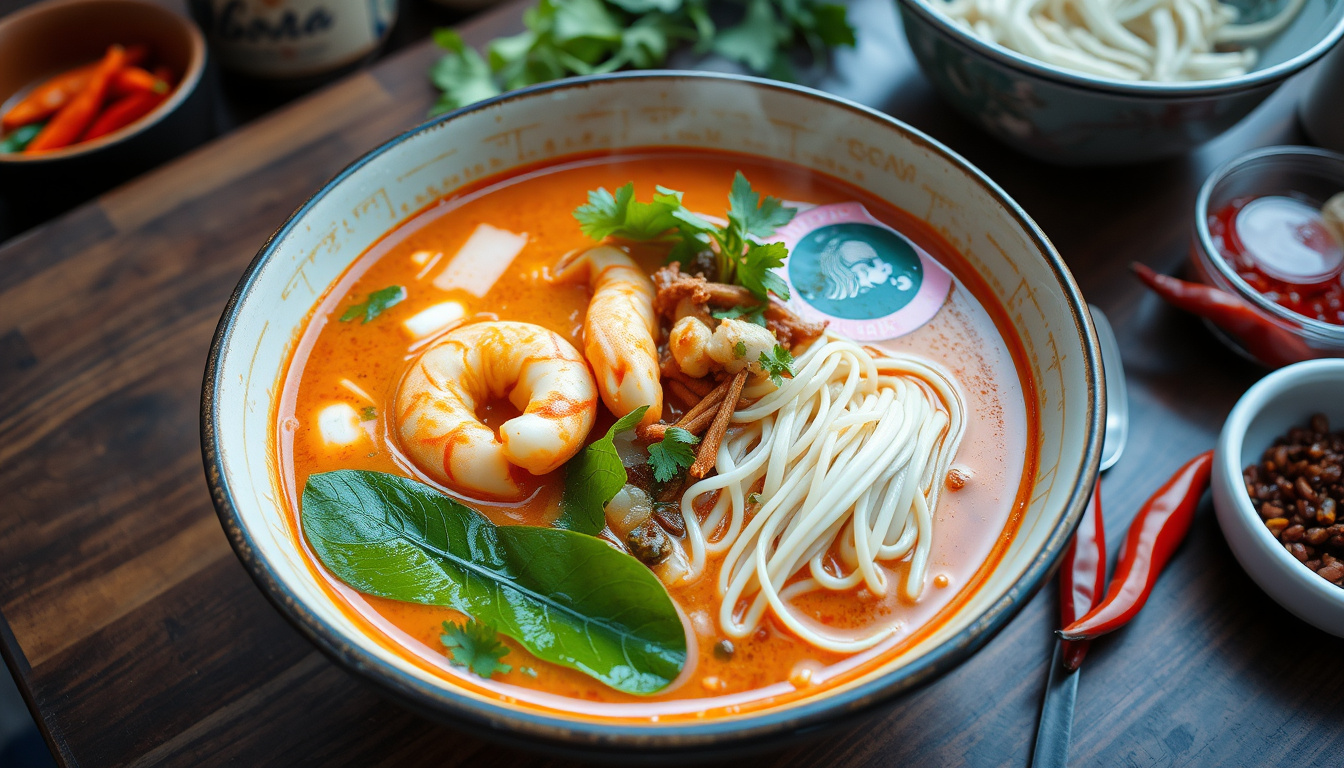
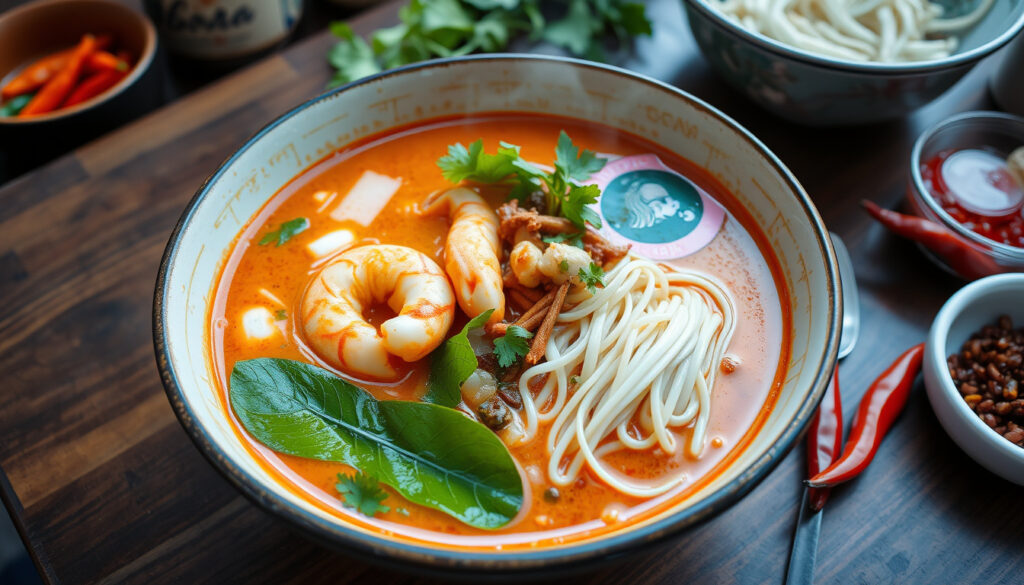
Few noodle dishes pack as much history into a single bowl as Singapore’s signature laksa. Born from the Peranakan crossroads of Chinese and Malay culinary traditions, this coconut-rich, chili-spiced broth has been winning devotion across the island since the 1950s. Whether you are hunting for a quick lunch near town or willing to trek across neighborhoods for that perfect bowl, the search for “laksa near me” is really a search for a living food culture. This guide maps the top stalls, breaks down the health picture, and sorts authentic ingredients from copycat approximations.
Origin: Singapore ·
Key Ingredient: Laksa leaves (rau ram) ·
Top Spot Example: 328 Katong Laksa ·
Health Debate: Coconut-rich broth ·
Global Variations: Singaporean style
Quick snapshot
- Katong Laksa popularized in Singapore’s east coast district in the 1950s–1960s (My Gentle Foods)
- Janggut Laksa traces lineage to descendants of a legendary street peddler nicknamed “Janggut” (AFAR)
- Rau ram is the English name for laksa leaves, also called Vietnamese coriander (Wikipedia)
- Exact calorie counts vary widely by stall and portion size
- No universally agreed “best stall” consensus — rankings shift between food bloggers
- Operating hours at smaller hawker stalls can change without notice
- Laksa emerged from 16th-century SE Asian spice trade routes (Jun & Tonic)
- Peranakan traders refined the dish by the end of the 19th century (Remote Lands)
- Katong-style variants took root in the 1950s–1960s (My Gentle Foods)
- 328 Katong Laksa continues expanding with multiple branches island-wide (328 Katong Laksa Official)
- Traditional hawker stalls face generational succession challenges (328 Katong Laksa Official)
- Health-conscious variants like Terry Katong Laksa are gaining traction (328 Katong Laksa Official)
| Label | Value |
|---|---|
| Dish Origin | Singapore |
| Signature Leaf | Rau ram |
| Example Stall | 328 Katong Laksa |
| Health Note | Spice-balanced coconut |
What is Singaporean laksa?
Singapore’s laksa falls under the Peranakan (Nyonya) tradition — a culinary fusion where Chinese immigrants blended rice noodles with Malay spices and coconut milk. The result is a bowl that carries both depth and heat. A proper Singapore laksa features a coconut milk broth that is both rich and spicy, rice noodles, dried shrimp, chili paste, cockles, shrimp, and fish cakes. Unlike other regional varieties that lean on tamarind or lighter broths, the Singapore version doubles down on creaminess and flavor intensity.
Ingredients breakdown
The signature element is the gravy itself — a coconut milk-enriched broth that gets its sandy texture from ground dried shrimp stirred into the base. Thick rice noodles, cut short so you can eat them with a spoon without chopsticks, anchor every bowl. Toppings typically include cockles, prawns, fish cakes, and a generous spoonful of sambal chili paste. The dish gets its name from the herb rau ram, also known as Vietnamese coriander, which adds a peppery brightness that ties all the flavors together.
Singapore vs other styles
Singapore’s Katong-style laksa differs sharply from regional counterparts. Penang’s assam laksa, for example, swaps coconut cream for a tangy tamarind-based fish broth, making it lighter and more sour. Johor laksa uses spaghetti-length noodles and often includes cucumber and bean sprouts. The Singapore version, by contrast, keeps its noodles thick and short and its broth unabashedly rich — a deliberate choice that defines the local palate.
Is laksa healthy or unhealthy?
The honest answer depends on which stall you visit and how often you eat. A standard bowl of Singapore laksa delivers roughly 500–700 calories, with the bulk coming from coconut milk fat and refined carbohydrates in the rice noodles. The coconut milk provides medium-chain triglycerides (MCTs) that can boost metabolism, and the spice blend — particularly the chili — contains capsaicin, which has anti-inflammatory properties. However, the sodium content from dried shrimp and sambal can add up quickly, especially if you order extra toppings.
Calorie count
Exact calorie counts vary by stall, but a typical serving lands in the 500–700 calorie range. Some stalls, like Terry Katong Laksa, have positioned themselves as cleaner alternatives by eliminating pork, lard, MSG, sugar, and evaporated creamer. If you are watching your intake, asking about broth preparation or choosing a stall that publishes nutritional information can help you stay within your targets.
Nutritional balance
The protein picture is solid — shrimp and fish cakes contribute lean protein — but the carb load from noodles and the fat from coconut milk mean the dish is best enjoyed as an occasional treat rather than a daily staple. Pairing your bowl with a light vegetable side or a green drink can help balance the meal. For those with dietary restrictions, some stalls offer vegetarian versions using tofu and vegetable stock, though these are less common in traditional hawker settings.
Key Ingredients
The dish relies on several distinct components: coconut milk for richness, dried shrimp for umami depth, chili paste for heat, cockles and prawns for seafood punch, fish cakes for texture, and rau ram (laksa leaves) for aromatic brightness. Each element plays a specific role in building the complex flavor profile that defines authentic Singapore laksa.
Where can I find good laksa in Singapore?
Singapore’s hawker landscape offers no shortage of laksa options, but the best bowls tend to come from stalls with decades of history and loyal neighborhood followings. Whether you are near the east coast or willing to cross the island for a claypot version, there is a specific stall worth knowing about for every situation.
Top stalls list
Three names consistently surface at the top of every credible list. 328 Katong Laksa at 216 East Coast Road is the most famous branch, attracts international visitors, and was famously visited by Gordon Ramsay. The Queensway Shopping Centre location keeps hours from 10am to 8:45pm. Janggut Laksa at Roxy Square, 50 East Coast Road, serves descendants of the legendary street peddler who helped popularize the dish — the AFAR travel magazine specifically highlights this lineage as part of Singapore’s living food heritage. Depot Road Zhen Shan Mei Laksa at Alexandra Village Food Centre is known for its claypot preparation and draws crowds from across the island.
Chinatown Complex spots
Sungei Road Laksa at 27 Jalan Berseh, #01-100 operates from 9:30am to 4pm on Mondays, Tuesdays, and Thursdays through Sundays, closed on Wednesdays. Terry Katong Laksa at Amoy Street Food Centre opens from 7:30am to 5pm on weekdays and 8:30am to 2pm on Saturdays, closed Sundays. For those already in the Newton or Toa Payoh area, Min Ji Laksa at Bendemeer Market & Food Centre serves from 8am to 3pm on most days except Thursdays.
328 Katong Laksa has become synonymous with the dish for international visitors, while Janggut Laksa represents the living legacy of Singapore’s original street peddlers. If you have time for only one bowl, factor in location and your appetite for history.
What are laksa leaves called in English?
The herb that gives Singapore laksa its distinctive peppery aroma is called rau ram in Vietnamese and is also known as Vietnamese coriander or Cambodian mint. Its scientific name is Persicaria odorata, and it is a key ingredient in Southeast Asian cooking across multiple cuisines. In the dish, rau ram leaves are typically added fresh as a garnish just before serving, lending a bright, herbaceous counterpoint to the rich coconut broth.
Identification
Rau ram has pointed, elongated leaves with a burgundy or dark red splotch in the center — a feature that makes it easy to distinguish from other herbs like regular cilantro or mint. The plant grows easily in tropical climates, which is why it is a staple in Singapore’s home kitchens and market gardens alike. When shopping for the herb, look for vibrant green leaves without wilting or yellowing, and use it the same day you buy it for maximum freshness.
Usage in dish
Chefs add rau ram as a finishing herb rather than cooking it into the broth. The leaves are typically torn by hand and scattered over the top of the bowl just before serving, preserving their volatile aromatic compounds. Some stalls also use the stems in the broth for deeper flavor infusion, though the leaves themselves are best added at the end to maintain their characteristic peppery bite.
If you are trying to recreate the dish at home, substituting regular cilantro or mint will give you a fundamentally different flavor profile. Rau ram’s peppery quality is not optional — it is part of what makes Singapore laksa distinctly itself.
What country has the best laksa?
Singapore makes a strong claim with its Katong-style bowls, but the honest answer is that every country in the region has developed a distinct interpretation worth trying. Malaysia alone hosts at least four major regional variants, while Singapore’s version has gained global recognition through celebrity endorsements and consistent presence on international food lists. The question is less about which country “wins” and more about which style matches your palate.
Six regional styles, one pattern: each uses coconut milk or tamarind as the broth base but diverges sharply on noodle shape, spice level, and protein choices.
| Region | Noodle Type | Broth Character | Key Topping |
|---|---|---|---|
| Singapore (Katong) | Thick, short rice noodles | Coconut-rich, spicy | Cockles, dried shrimp |
| Penang, Malaysia | Thin rice vermicelli | Tamarind tangy, fish-heavy | Mint, pineapple |
| Johor / Siglap | Long laksa noodles | Coconut spicy | Cucumber, bean sprouts |
| Sarawak, Malaysia | Rice vermicelli | Sambal belacan coconut tamarind | Chicken omelette |
| Singapore (Claypot) | Thick short noodles | Reduced coconut, smoky | Egg, tofu pok |
| Terry Katong (Health) | Thick short noodles | Clean coconut, no MSG | Cockles, fish cake |
Singapore claim
Singapore’s version stands out for its creamy broth and the deliberate spoon-eating experience that comes from short-thick noodles. The Katong district in the east coast remains the spiritual home, where the dish was refined and popularized in the 1950s–1960s. Food blogger Daniel Food Diary has compiled what appears to be the most comprehensive 2025 guide to the island’s top stalls, with verified addresses and hours for over a dozen locations.
Global takes
Penang’s assam laksa has its own passionate following and was listed by CNN as one of the world’s best soups. Sarawak’s version adds a unique chicken omelette alongside the noodles. Even Hong Kong has developed its own variations, though these tend to use lighter broths suited to local tastes. The beauty of the dish is that each interpretation reflects its region’s ingredients, climate, and culinary priorities — there is no single “correct” version, only versions that are more or less authentic to their origins.
“Whether you crave rich, coconut-heavy gravy or a lighter, tangier broth, this guide brings together some of the best Laksa stalls in Singapore, each serving up a bowl worth travelling for.”
— Daniel Food Diary (Food Blogger)
“Descendants of a legendary laksa street peddler nicknamed Janggut serve a creamy-complex version.”
— AFAR (Travel Magazine)
Upsides
- Singapore’s hawker culture ensures multiple high-quality stalls with verified addresses and hours
- Strong anti-inflammatory benefits from spices like turmeric and galangal in traditional recipes
- Clear Peranakan heritage that gives each stall a documented lineage
- Authentic versions widely available at affordable hawker prices
Downsides
- Calorie density from coconut milk can be high for diet-conscious diners
- No universally agreed ranking for “best stall” — rankings shift between food bloggers
- Exact operating hours at smaller hawker stalls can change without notice
- MSG and high sodium content common in traditional broths at most stalls
Related reading: Best tequenos near me · Best Indian restaurant Toronto
danielfooddiary.com, nickblitzz.sg, nisabakrigourmet.com, youtube.com, ice.edu
Related coverage: top authentic laksa venues fördjupar bilden av Singapore Laksa Near Me – Mejores Lugares Auténticos en Singapur.
Frequently asked questions
How spicy is Singapore laksa?
Most Singapore laksa falls in the medium-to-hot range. The heat comes primarily from sambal chili paste, which stall keepers add to taste. Some places offer milder versions by request, but expect at least a gentle burn if you order the standard preparation.
What noodles are used in laksa?
Singapore’s Katong-style laksa uses thick rice noodles that are cut short — approximately 1–2 inches in length — so diners can eat them with a spoon. This is distinct from Penang assam laksa, which uses thin vermicelli, and Johor laksa, which uses longer noodles resembling spaghetti.
Can laksa be vegetarian?
Traditional Singapore laksa contains shrimp, cockles, and dried shrimp in the broth, making it non-vegetarian. However, some stalls have experimented with vegetable-based broths using mushroom or tofu substitutes. These versions are less common at hawker centers and may not capture the authentic flavor profile.
How much does laksa cost in Singapore?
A bowl of laksa at a hawker stall typically costs between SGD 4 and SGD 8, depending on location and toppings. Higher-end food court versions or restaurant presentations may reach SGD 10–15. The price-to-quality ratio at traditional stalls is generally excellent.
Is laksa gluten-free?
The rice noodles used in Singapore laksa are naturally gluten-free, and the broth itself contains no wheat-based ingredients. However, cross-contamination at shared hawker stalls is possible, and some stalls may add soy sauce or other gluten-containing condiments. Celiac sufferers should verify with the stall before ordering.
What to pair with laksa?
The dish is satisfying enough to stand alone, but many locals pair it with a refreshing drink like bandung (rose syrup and milk) or teh halia (tea with ginger). For a balanced meal, adding a side of blanched vegetables or a hard-boiled egg increases the protein and fiber content without dramatically changing the flavor profile.
Differences between laksa types?
The six major regional varieties divide roughly into coconut-forward styles (Singapore Katong, Johor, Sarawak) and tamarind-forward styles (Penang assam). The biggest differences are in broth base, noodle shape, and protein choices. Singapore’s version is uniquely characterized by thick short noodles, a rich coconut-spice broth, and the use of rau ram as a garnish.
For anyone serious about Singapore’s food culture, the choice between a packaged instant approximation and a bowl from an actual hawker stall is not subtle. The real thing has history, texture, and a depth of flavor that no shelf-stable packet can replicate. Whether you end up at 328 Katong Laksa in the east or make the trek to Depot Road in Alexandra Village, you are eating something that traces its roots to street peddlers in the 1950s — and that connection is part of what makes every spoonful worth the search.
Related stories





Jessica Morin is Provincial Affairs Editor at Toronto Post, covering Ontario policy, provincial politics and regional economics.