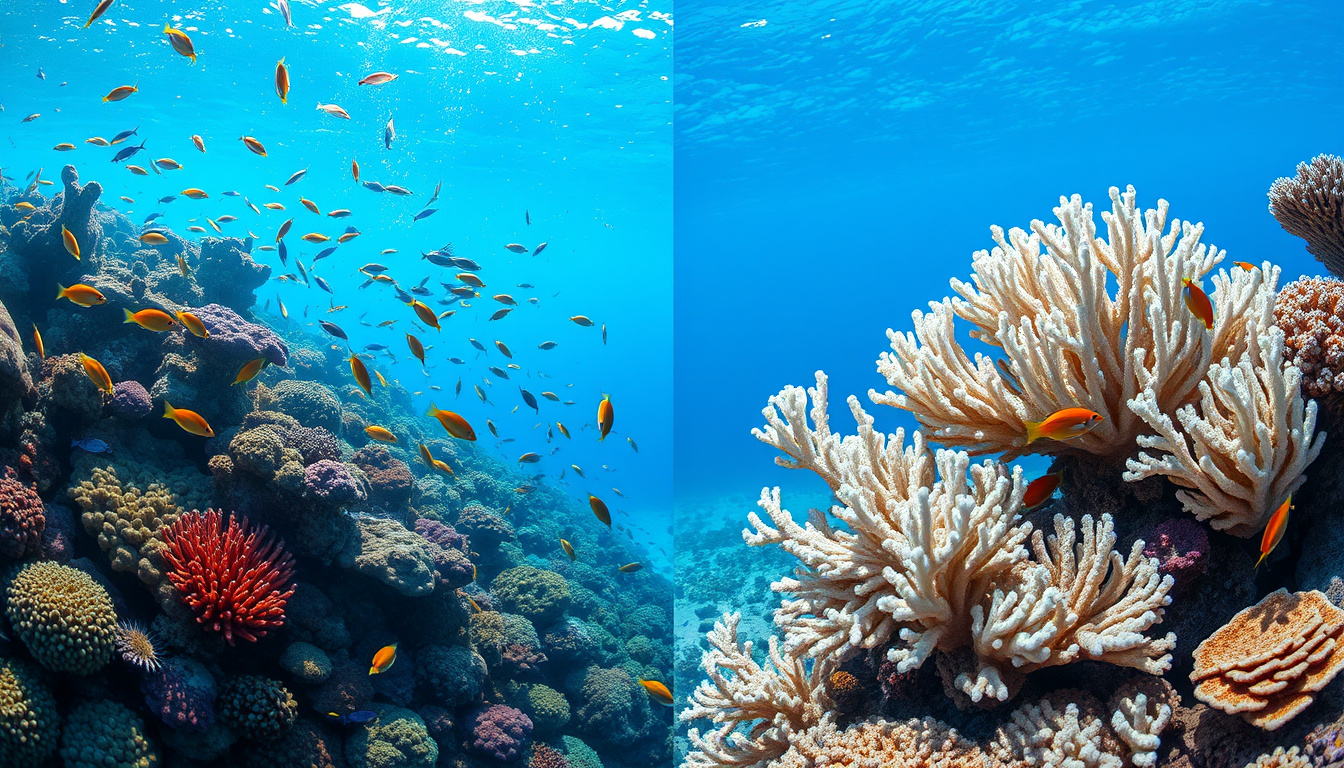
Coral reefs are living structures built by tiny coral polyps, covering less than 1% of the ocean floor but hosting 25% of all marine species. They protect coastlines and support billions of dollars in tourism and fishing — yet these ecosystems are in crisis, and the next few years may decide their fate.
Ocean coverage: Less than 1% ·
Marine species supported: 25% ·
Economic value (annual): $36 billion ·
Reefs at risk: 75%
Quick snapshot
- Corals are animals, not plants, related to jellyfish (NOAA Coral Reef Watch)
- Reefs cover less than 1% of the ocean floor but host 25% of marine species (NOAA Coral Reef Watch satellite report)
- Climate change is the primary long-term threat (UNESCO World Heritage Centre)
- Will all coral reefs be gone by 2030? — Uncertain; depends on emissions and conservation (GCRMN 2025 report)
- Exact recovery rate of restored reefs varies by region and species (Australian Institute of Marine Science – AIMS 2024/25 report) (GCRMN 2025 report)
- 1950s: beginning of significant coral decline from human activities (GCRMN 2025 report)
- 1998: first major global bleaching event linked to El Niño (NOAA Coral Reef Watch)
- 2016: severe bleaching on Great Barrier Reef – 93% of corals affected (AIMS 2024/25 report)
- 2030 (projected): potential loss of 70-90% if warming exceeds 1.5°C (Wildlife Conservation Society – WCS)
- Global emissions pathway will be decisive (UNESCO World Heritage Centre)
- Active restoration and local protections may help some reefs persist (International Coral Reef Initiative – ICRI Forum)
Key statistics about coral reefs provide a quick overview of their scale and importance.
| Total area of coral reefs | ~284,300 km² (NOAA Coral Reef Watch) |
|---|---|
| Percentage of ocean floor | <1% (NOAA Coral Reef Watch) |
| Marine species depending on reefs | 25% (NOAA Coral Reef Watch) |
| Economic contribution (annual) | $36 billion (NOAA Coral Reef Watch) |
What is the coral reef?
Definition of a coral reef
- Coral reefs are underwater ecosystems built by colonies of coral polyps — tiny animals related to jellyfish and sea anemones (NOAA Coral Reef Watch).
- They are composed of calcium carbonate skeletons secreted by the polyps (GCRMN 2025 report).
- Reefs are found in shallow, warm, clear, sunlit waters, mostly between 30°N and 30°S latitude (WCS).
How coral reefs form
Reefs begin when a free-swimming coral larva attaches to a hard surface and metamorphoses into a polyp. The polyp then clones itself into thousands of identical polyps, each building a calcium carbonate cup. Over centuries, these colonies fuse into a structure that can become massive. The Great Barrier Reef, for instance, began forming about 500,000 years ago, though its living surface is much younger (Wikipedia).
The process depends on symbiotic algae called zooxanthellae that live inside coral tissue. The algae perform photosynthesis and provide up to 95% of the polyp’s energy needs. This relationship is why reefs need sunlight to thrive (NOAA Coral Reef Watch).
A single coral colony is an animal, a plant (via its algae partner), and a mineral builder all in one — a biological trifecta that makes reefs the most productive ecosystems on the planet.
Types of coral reefs
- Fringing reefs – grow directly from the shore.
- Barrier reefs – separated from land by a deep lagoon; the Great Barrier Reef is the largest example.
- Atolls – ring-shaped reefs that enclose a central lagoon, often atop submerged volcanoes (NOAA Coral Reef Watch).
The pattern: three basic shapes, but all share the same core building block — a polyp no bigger than a pinhead.
Why are coral reefs important?
Biodiversity hotspots
Although reefs cover less than 1% of the ocean floor, they support roughly 25% of all marine species — including 4,000 species of fish, 700 species of coral, and countless invertebrates (NOAA Coral Reef Watch). This makes them the rainforests of the sea. A single patch of reef can host more species per square meter than any other marine habitat (GCRMN 2025 report).
Coastal protection
Reefs act as natural breakwaters, absorbing up to 97% of a wave’s energy. This reduces flooding and erosion for an estimated 200 million people living in coastal communities (UNESCO World Heritage Centre). A 2025 study on the Great Barrier Reef found that without it, coastal damage from storms would double in parts of Queensland (Taylor & Francis journal article).
Economic value
- Global fisheries: about $6 billion annually (NOAA Coral Reef Watch).
- Tourism and recreation: approximately $36 billion per year globally (NOAA Coral Reef Watch).
- GBR alone: estimated economic, social and icon asset value of AU$56 billion; contributes $6.4 billion to the Australian economy (Taylor & Francis journal article).
The implication: losing reefs is not just an ecological tragedy — it’s a direct hit on the livelihoods of half a billion people who depend on them for food and income.
Are coral reefs still dying?
Current state of coral reefs
The short answer is yes, but the picture is more nuanced than many headlines suggest. From 1 January 2023 to 30 September 2025, bleaching-level heat stress impacted about 84.4% of the world’s coral reef area, according to NOAA Coral Reef Watch. The fourth global mass bleaching event, first declared in 2024, likely ended in 2025, but the cumulative damage is massive (NOAA Coral Reef Watch). On the Great Barrier Reef, the 2024/25 AIMS survey found that 48% of surveyed reefs declined in coral cover, 42% showed no net change, and only 10% increased (Australian Institute of Marine Science).
Major causes: bleaching, acidification, overfishing
- Thermal bleaching – a 1°C rise above the normal summer maximum for two weeks triggers corals to expel their symbiotic algae, often leading to death (NOAA Coral Reef Watch).
- Ocean acidification – absorbed CO₂ lowers seawater pH, reducing the availability of carbonate ions that corals need to build their skeletons (GCRMN 2025 report).
- Overfishing and pollution – remove herbivorous fish that keep algae in check, and runoff from agriculture smothers reefs with sediment and nutrients (UNESCO World Heritage Centre).
Regional reports: signs of resilience
Not all news is bleak. Some reefs in the Phoenix Islands Protected Area and parts of the Indo-Pacific have shown surprising recovery after bleaching events. A 2025 GCRMN report notes that local factors — especially water quality and effective fisheries management — can significantly boost a reef’s ability to withstand heat stress (GCRMN 2025 report). The Australian Institute of Marine Science also emphasizes patchiness: “Reef conditions can vary sharply by region and by year, reflecting the patchy nature of coral bleaching and recovery” (AIMS 2024/25 report).
Resilience exists, but only where local stressors are minimized. The global driver — rising ocean temperatures — is still the ace of spades. Without emissions cuts, even the toughest reefs will eventually hit their thermal ceiling.
The takeaway: local conservation can buy time, but emissions cuts are the only long-term solution.
Where are the top 3 largest coral reefs in the world?
- Great Barrier Reef (Australia) – spans over 2,300 km, the largest in the world (UNESCO World Heritage Centre).
- Mesoamerican Barrier Reef – extends more than 1,000 km from the Yucatán Peninsula to Honduras (WCS).
- New Caledonia Barrier Reef – second longest, at about 1,500 km surrounding New Caledonia (NOAA Coral Reef Watch).
Three giants dominate, but the Great Barrier Reef alone contains roughly 2,900 separate reef systems and 900 islands — underscoring its critical role in global reef conservation.
What are 5 facts about coral reefs?
- Corals are animals. Each polyp is a tiny animal that captures plankton with stinging tentacles (NOAA Coral Reef Watch).
- Some reefs are over 50 million years old. The oldest known reef fossils date back to the Ordovician period, but modern family lines emerged after the last ice age (GCRMN).
- Symbiotic algae (zooxanthellae) are essential. They provide 90-95% of a coral’s energy through photosynthesis (NOAA Coral Reef Watch).
- A 1°C rise in water temperature can trigger bleaching. Even a slight sustained increase above the summer maximum stresses corals to the point of expulsion (NOAA Coral Reef Watch).
- 25% of marine species depend on reefs at some point in their lifecycle. That includes 4,000+ fish species and countless invertebrates (NOAA Coral Reef Watch).
These five facts highlight the biological uniqueness and vulnerability of coral reefs.
Timeline: Coral reef decline and response
- 1950s – Beginning of significant coral decline due to increased human activities: coastal development, fishing pressure, and pollution (GCRMN).
- 1998 – First major global coral bleaching event linked to a strong El Niño, killing an estimated 16% of the world’s reefs (NOAA Coral Reef Watch).
- 2016 – Severe bleaching on the Great Barrier Reef affects 93% of its corals; some sections lose more than 50% of live coral cover (AIMS).
- 2024 – IPCC Special Report on Oceans and Cryosphere states with high confidence that further declines are expected under current warming pathways (GCRMN). The Great Barrier Reef Outlook Report 2024 is published, identifying climate change as the primary threat (UNESCO).
- 2025 – Fourth global bleaching event likely ends, but 84.4% of global reef area experienced bleaching-level heat stress since January 2023 (NOAA Coral Reef Watch). AIMS reports 48% of GBR sites declined in coral cover.
- 2030 (projected) – If global warming exceeds 1.5°C, 70-90% of coral reefs could be lost (WCS).
The pattern: each heat peak arrives faster and hits harder. The time between bleaching events has shrunk from decades to just a few years in some regions.
Confirmed facts vs. what remains unclear
Confirmed facts
- Coral reefs are dying due to climate change and local stressors — evidence from NOAA, GCRMN, and AIMS is unanimous (NOAA, GCRMN, AIMS).
- Touching coral can damage its protective mucus layer, making it vulnerable to infection and death (NOAA Coral Reef Watch).
- Corals rely on symbiotic algae (zooxanthellae) for nutrition — this is a foundational biological fact (NOAA Coral Reef Watch).
What’s unclear
- Will all coral reefs be gone by 2030? – Unlikely. The “all gone by 2030” trope is a media simplification. Even under worst-case scenarios, some deep and resilient patches will persist, but 2030 is the year when many bleached reefs could reach a point of no return if emissions don’t peak (GCRMN).
- Exact rate of recovery in restored reefs – Highly variable; depends on genetics, larval supply, and local water quality (AIMS).
- Can coral evolve fast enough to keep up with warming? – Some evidence of “super corals” in extreme environments, but it’s unclear whether this can scale (NOAA Coral Reef Watch).
- Over 90% of coral reefs could be lost by 2050 – This projection assumes continued high emissions; uncertainties remain (WCS).
What this means: while the science is settled on many fronts, the exact future of reefs depends on uncertain factors like future emissions and local management effectiveness.
Perspectives from the field
“Coral reefs are among the most vulnerable ecosystems on the planet to anthropogenic pressures, including climate change and ocean acidification.”
“Climate change remains the primary long-term threat to the Outstanding Universal Value of the Great Barrier Reef.”
— UNESCO World Heritage Centre, summarizing the 2024 Outlook Report
“Reef conditions can vary sharply by region and by year, reflecting the patchy nature of coral bleaching and recovery.”
— Australian Institute of Marine Science, 2024/25 Annual Summary
These authoritative voices consistently identify climate change as the overarching threat to coral reefs worldwide.
For policymakers in the world’s 50+ reef nations, the decision window is narrowing: invest heavily in local water quality management, no-take zones, and active restoration — or watch the best-case scenario slip away. For the average consumer and traveler, the concrete action is simple: choose reef-safe sunscreen, reduce carbon footprint, and support marine protected areas. The reefs won’t survive on hope alone; they need decisions made today to match the scale of the threat. For Australian and global communities, the trade-off is clear: act aggressively on emissions and local stressors, or accept a future where the only coral reefs left are in documentaries.
Related reading: Skills to Put on Resume · Best Finance Books Classified by Level and Topic
wcs.org, icriforum.org, en.wikipedia.org, gcrmn.net, youtube.com, coralrestoration.org, tandfonline.com
For a deeper dive into the specifics of coral reef definition and conservation, you can read about the definition, threats and protection of coral reefs in a detailed guide.
Frequently asked questions
Is coral a plant or an animal?
Coral is an animal. Each coral polyp is a tiny invertebrate related to jellyfish and sea anemones. It has a mouth, tentacles, and a stomach, and it catches plankton for food (NOAA Coral Reef Watch).
How long do coral reefs live?
Individual colonies can live for centuries — some massive brain corals are over 500 years old. Reef structures themselves can be thousands of years old, built layer by layer (NOAA Coral Reef Watch).
Can coral reefs recover from bleaching?
Yes, if the heat stress subsides quickly and water quality is good. Recovery can take a decade or more, and it often depends on the arrival of new larvae from healthier reefs. Repeated bleaching can prevent recovery (AIMS).
What is coral bleaching?
When water temperature exceeds the normal summer maximum by just 1°C for two weeks or more, corals expel the symbiotic algae (zooxanthellae) living in their tissues. Without the algae, the coral’s white skeleton shows through — that’s bleaching. If high temperatures persist, the coral starves and dies (NOAA Coral Reef Watch).
How do humans destroy coral reefs?
Primarily through climate change (warming and acidifying oceans), but also by overfishing, coastal development, pollution (including sunscreen chemicals), and physical damage from anchors and tourism (UNESCO World Heritage Centre).
What is the difference between hard and soft coral?
Hard corals (stony corals) extract calcium carbonate from seawater to build a rigid skeleton — they are the main reef builders. Soft corals lack a hard skeleton and are more flexible; they often look like plants or fans with visible tentacles (NOAA Coral Reef Watch).
Are all coral reefs in warm water?
Most reef-building corals require warm water (20-29°C) and sunlight, but deep-sea corals exist in cold, dark waters as deep as 6,000 meters. They grow much slower and do not form the same type of sunlit reef structure (NOAA Coral Reef Watch).
These answers address common questions and provide clarity on coral reef biology and threats.
Related stories





Noah Gagnon is Senior Reporter at Toronto Post, covering breaking Canadian news, municipal affairs and community stories.