Anyone who’s ever been flattened by a pneumonia cough knows that the question “How long will this last?” feels urgent from the first fever spike. According to the American Lung Association (respiratory health authority), recovery can take anywhere from a week to more than a month depending on the type and severity.
Global annual pneumonia cases: 450 million (WHO) ·
Typical recovery time: 1 week to ≥1 month (American Lung Association) ·
Cough duration after antibiotics: 2–3 weeks (HSE Ireland) ·
Walking pneumonia duration: 4–6 weeks (Cleveland Clinic)
Quick snapshot
- Bacterial pneumonia is treated with antibiotics for 5–7 days (American Medical Association)
- Full recovery from community-acquired pneumonia can take 6–8 weeks (American Medical Association)
- Walking pneumonia (Mycoplasma) can last 4–6 weeks (Cleveland Clinic)
- Exact recovery time varies widely by age, overall health, and pneumonia type (Cleveland Clinic)
- Whether all four stages of pneumonia are clinically distinct in every patient is debated (Cleveland Clinic)
- How long you remain contagious after starting antibiotics is not precisely known (Cleveland Clinic)
- Improvement in symptoms can begin within 24–48 hours after starting antibiotics (Cleveland Clinic)
- Temperature usually settles within 48 hours, gone within a week (NHS Greater Glasgow and Clyde)
- Chest symptoms improve within 4 weeks; breathing easier within 6 weeks (NHS Greater Glasgow and Clyde)
- Finish all prescribed antibiotics even if you feel better (Cleveland Clinic)
- Rest is crucial; overexertion can prolong recovery (Cleveland Clinic)
- Watch for danger signs: difficulty breathing, chest pain, confusion (Cleveland Clinic)
Six numbers capture pneumonia’s global impact and recovery patterns — each one tied to a specific source.
| Metric | Value |
|---|---|
| Annual global pneumonia cases | ~450 million (WHO) |
| Hospitalizations in the US | ~1 million per year (CDC) |
| Mortality rate (developed countries) | ~5% (lower with early treatment) |
| Average recovery time (bacterial, treated) | 1–3 weeks for symptoms, full recovery 1–6 months |
| Cough persistence after treatment | 2–3 weeks (HSE) |
What are the 4 stages of pneumonia?
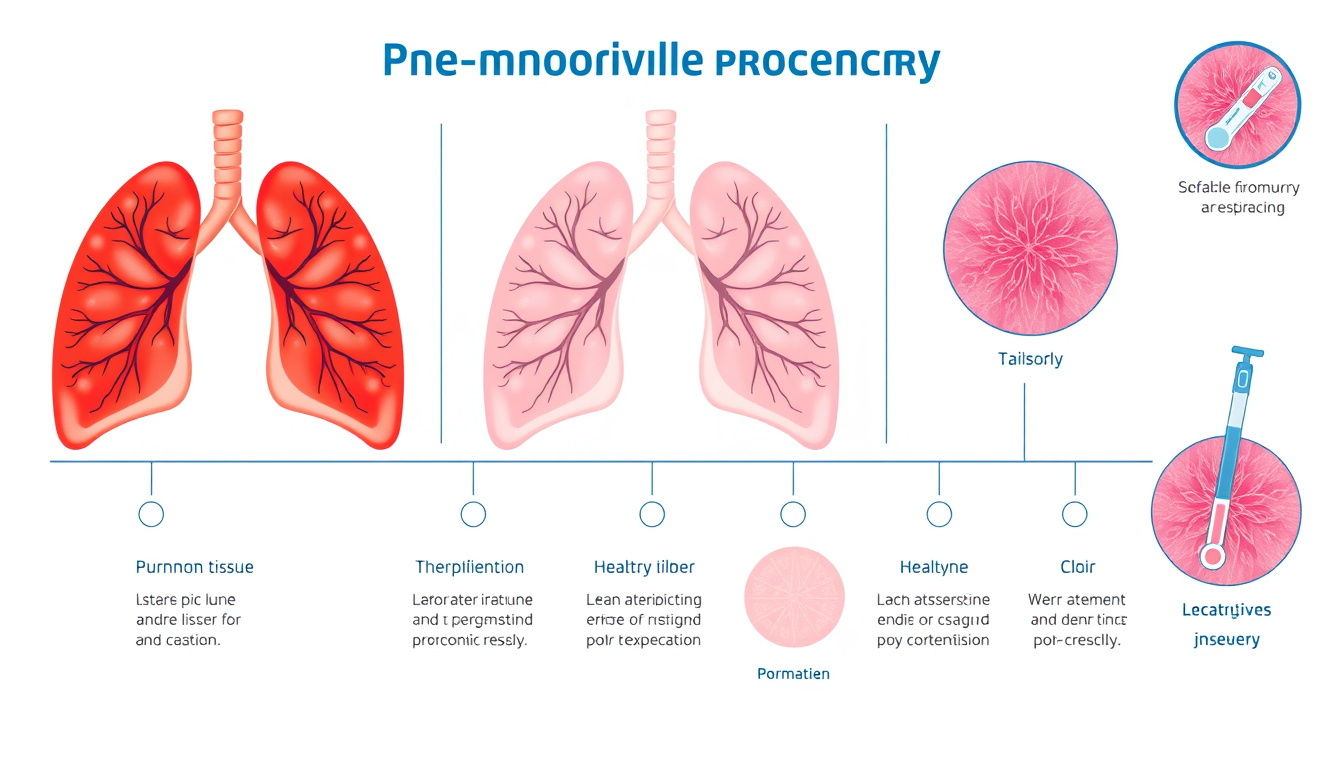
Doctors describe the progression of lobar pneumonia in four histological stages, though not every patient passes through all of them clinically.
How long does each stage last?
- Congestion (first 24–48 hours): Fluid and immune cells accumulate in the alveoli. Inflammation begins.
- Red hepatization (2–4 days): Red blood cells and neutrophils fill the lung tissue, giving it a liver-like firmness. Fever spikes.
- Gray hepatization (4–7 days): Red blood cells break down, fibrin deposits turn the lung grayish. Breathing becomes labored.
- Resolution (ongoing, often 1–3 weeks): Phagocytes clear debris, and lung tissue slowly repairs itself.
The four-stage model is based on classic pathology — but antibiotics and early treatment can truncate or blur these boundaries. The catch: Many patients never experience all four stages, especially with prompt care. The real-world timeline depends more on the type of pneumonia and the person’s immune response than on stage progression alone.
What are the symptoms of each stage?
- Congestion: Dry cough, mild fever, fatigue.
- Red hepatization: Productive cough (rust-colored sputum), high fever, chills, chest pain on breathing.
- Gray hepatization: Persistent cough, shortness of breath, possible cyanosis (bluish lips or fingertips).
- Resolution: Cough becomes less frequent, sputum clears, breathing eases, energy returns gradually.
A patient who recognizes “gray hepatization” symptoms knows the lungs are at their most compromised. At that point, oxygen monitoring and hospital care may be the difference between a week in bed and a month in recovery.
The implication: early treatment can dramatically alter the classic progression, making stage-based timelines less reliable for modern patients.
How long does pneumonia stay in your lungs?
The infection itself clears within days for bacterial cases treated with antibiotics, but the inflammation and repair take much longer. Three common types follow different clocks.
How long does walking pneumonia last?
- Walking pneumonia (usually Mycoplasma pneumoniae) can last 4–6 weeks (Cleveland Clinic).
- Symptoms are milder but linger — cough, low-grade fever, and fatigue may drag on for over a month.
- It remains contagious until the person feels better and has been fever-free for a few days (Cleveland Clinic).
How long does viral pneumonia last?
- Viral pneumonia typically resolves in 1–3 weeks without antibiotics (Cleveland Clinic).
- Supportive care (rest, fluids, fever reducers) is the main treatment.
- Cough and fatigue can outlast the infection by days or weeks.
How long does pneumonia last after antibiotics?
- For bacterial pneumonia, antibiotics are prescribed for 5–7 days (American Medical Association).
- Most symptoms improve within 24–48 hours of starting treatment if you’re otherwise healthy (Cleveland Clinic).
- However, the cough can persist for 2–3 weeks after the antibiotic course ends (NHS Greater Glasgow and Clyde).
- Full recovery, including lung healing and energy returning, may take 1–6 months.
The catch: symptom improvement and full healing operate on different clocks, and patients often mistake one for the other.
Faster symptom relief from antibiotics doesn’t mean the lungs are fully repaired. Patients who go back to work after 3 days of medication risk a setback because the lung tissue is still inflamed and vulnerable.
What helps cure pneumonia faster?
Is it better to rest or be active with pneumonia?
- Rest is essential. Overexertion can delay healing and increase the risk of complications (American Medical Association).
- Light activity (walking to the bathroom) is fine, but avoid anything that raises your heart rate until your fever has been gone for 48 hours.
- Gradual return to normal activities after the acute phase — don’t rush.
What medications are used to treat pneumonia?
- Antibiotics for bacterial pneumonia — typically a 5–7 day course (NHS Greater Glasgow and Clyde).
- Antivirals may be used for influenza-related pneumonia (not common for other viruses).
- Fever reducers like acetaminophen can help with symptoms.
- Finish the full antibiotic course even if you feel better (Cleveland Clinic).
What home remedies or lifestyle changes help recovery?
- Stay well-hydrated — water, herbal tea, warm broths.
- Use a humidifier or take steamy showers to loosen congestion.
- Sleep with your head elevated to ease breathing.
- Breathing exercises (like pursed-lip breathing) can help clear mucus.
- Avoid smoking and secondhand smoke.
- Start antibiotics promptly if bacterial pneumonia is diagnosed (American Medical Association).
- Rest until you have been fever-free for at least 48 hours without fever reducers.
- Stay well-hydrated with water, herbal tea, and broths.
- Use acetaminophen for fever and pain as needed.
- Monitor your symptoms daily and call a doctor if they worsen after 48 hours of antibiotics.
The pattern: rest remains the most effective accelerator across all pneumonia types.
What are signs that pneumonia is improving?
When can I return to normal activities after pneumonia?
- Return to work or school once your fever has stopped and you feel improvement (American Medical Association).
- But expect fatigue and cough to linger for weeks. Pacing yourself is key.
- Full return to exercise should wait until you can walk a mile without getting winded.
How do I know if my infection is clearing?
- Fever subsides — temperature returns to normal and stays there.
- Cough changes — becomes less frequent and more productive (you’re clearing out debris).
- Breathing eases — you can take deeper breaths without chest pain.
- Appetite and energy slowly return.
- Your oxygen levels (if monitored) stay above 95% on room air.
Improvement isn’t linear. Some days you’ll feel better, the next day a bit worse. That’s normal. The pattern to watch for is a steady trend upward — if you’re worse after 48 hours of antibiotics, call your doctor.
The takeaway: recovery is rarely linear, but the overall trend matters more than day-to-day fluctuations.
What are the danger signs in pneumonia?
Is pneumonia deadly?
- Yes, but mortality in developed countries is around 5% with early treatment.
- Sepsis and respiratory failure are the leading causes of death.
- Risk is highest in older adults, young children, and people with weakened immune systems.
What are the last stages of pneumonia before death?
- Severe respiratory distress — gasping for air despite oxygen therapy.
- Confusion or altered mental state from low oxygen or sepsis.
- Multi-organ failure (kidneys, liver, heart).
When should I go to the hospital for pneumonia?
- Difficulty breathing (shortness of breath at rest).
- Chest pain that worsens with coughing or breathing.
- High fever that doesn’t respond to medication (above 102°F / 39°C).
- Confusion (especially in older adults).
- Bluish lips or fingertips (cyanosis).
- In children: grunting, nasal flaring, or chest indrawing.
If you or a loved one with pneumonia develops confusion, rapid breathing, or blue-tinged skin, call 911 immediately. These are signs that the infection has overwhelmed the body’s ability to oxygenate — minutes matter.
What this means: recognizing these signs early can be life-saving, and delay in seeking care is the primary risk.
Pneumonia Recovery Timeline
The timeline below shows the typical progression from onset to full recovery.
| Time period | What happens |
|---|---|
| Day 1–3 | Initial symptoms: fever, cough, fatigue; incubation ends. Antibiotics begin for bacterial cases. |
| Day 3–7 | Peak illness: worsening cough, chest pain, possible hospitalization. Fever may spike. Symptoms should improve within 48 hours of antibiotics (Cleveland Clinic). |
| Week 2–4 | Slow improvement: fever subsides, cough lingers, energy gradually returns. Chest symptoms improve within 4 weeks (NHS Greater Glasgow and Clyde). |
| Month 1–6 | Full recovery: lung function returns to normal, cough resolves, strength regained. Some may still feel tired after 3 months; most feel back to normal at 6 months (NHS Greater Glasgow and Clyde). |
The timeline underscores that full recovery is a matter of months, not days.
What’s Known and What’s Uncertain About Pneumonia Recovery
Confirmed facts
- Antibiotics treat bacterial pneumonia but not viral pneumonia (American Medical Association).
- Rest is essential for recovery; exercise can delay healing.
- Walking pneumonia is contagious and can last 4–6 weeks (Cleveland Clinic).
- Full recovery can take 6–8 weeks including imaging normalization (American Medical Association).
What’s unclear
- Exact recovery time varies greatly by age, overall health, and type of pneumonia.
- Whether all four stages of pneumonia are clinically distinct in every patient is debated.
- The precise duration of contagiousness after starting antibiotics is not well defined (Cleveland Clinic).
- Whether cough suppressants are helpful in pneumonia recovery is not well studied.
The gap: uncertainty in individual recovery times makes it impossible to give one-size-fits-all advice.
Expert Perspectives on the Recovery Experience
Many people start to feel better after a few days of antibiotics and rest. But you might cough, feel tired or have other lingering symptoms for longer.
Cleveland Clinic
Some people feel better and are able to return to their normal routines within a week. For other people, it can take a month or more.
You may still have a cough for 2 to 3 weeks after you finish your course of antibiotics. You may feel tired for even longer as your body recovers.
The gap between feeling better and being fully healed is where most pneumonia patients stumble. For the patient eager to go back to work, the choice is clear: wait until you’ve been fever-free for 48 hours and your cough is manageable, or risk a relapse that could double your recovery time.
newportchildren.com, houstonmethodist.org, lung.org, austinpulmonary.com, nhlbi.nih.gov
Related coverage: COVID-19 recovery timelines fördjupar bilden av How Long Does COVID Last? Duration, Recovery & Contagiousness.
Frequently asked questions
Is pneumonia contagious?
Yes, bacterial and viral pneumonia are contagious. Walking pneumonia (Mycoplasma) is also contagious. You can spread it through respiratory droplets when coughing or sneezing.
How long is pneumonia contagious?
For bacterial pneumonia, you’re usually no longer contagious after 24–48 hours of effective antibiotics and when your fever has subsided. For viral pneumonia, you may be contagious until symptoms improve and you’ve been fever-free for several days (Cleveland Clinic).
What gets mistaken for pneumonia?
Bronchitis is the most common condition mistaken for pneumonia. Others include asthma exacerbation, COPD, heart failure, and even pulmonary embolism. A chest X-ray is the definitive way to differentiate.
Can pneumonia go away on its own?
Viral pneumonia can resolve on its own with supportive care, but bacterial pneumonia usually requires antibiotics. Even viral cases can become serious and need medical attention.
Do I need to stay home from work with pneumonia?
Yes, you should stay home until your fever has stopped and you feel improvement. Returning too early can prolong recovery and spread infection to coworkers (American Medical Association).
Can pneumonia come back?
Yes, pneumonia can recur, especially in people with weakened immune systems, chronic lung disease, or who don’t complete their antibiotic course (Cleveland Clinic).
What is the difference between pneumonia and bronchitis?
Bronchitis affects the bronchial tubes (airways), while pneumonia infects the lung tissue (air sacs). Pneumonia is generally more severe and can cause fever and chest pain that bronchitis usually doesn’t.
The overarching theme: most questions about pneumonia recovery hinge on the distinction between feeling better and being healed.
Related reading
Related stories





Kevin Sullivan is Community & Events Correspondent at Toronto Post, covering neighbourhoods, community stories, events and local culture.