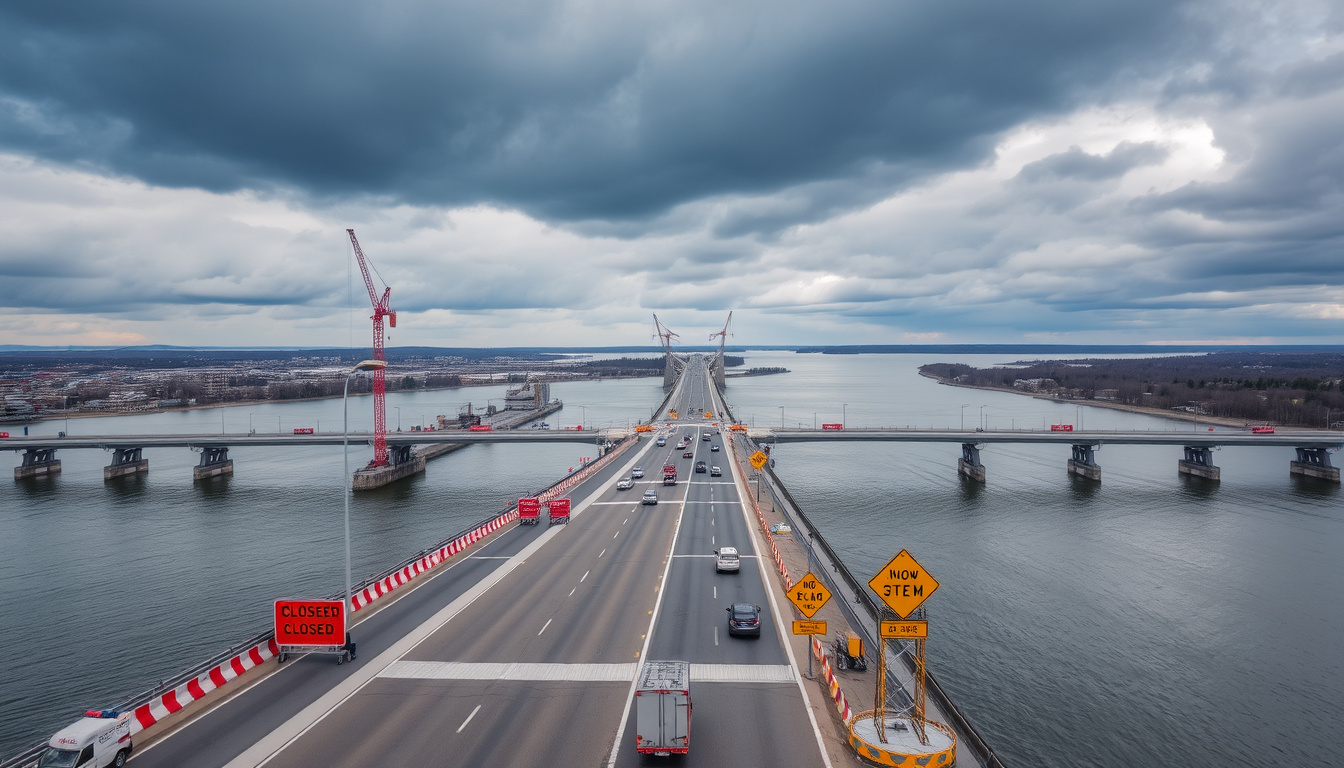

If you drive between Montreal and Montérégie on Autoroute 40, you’ve probably noticed the orange cones and shifting lane patterns near the Île-aux-Tourtes Bridge. The bridge that carries 81,000 vehicles daily is in the middle of a $2.3 billion reconstruction that will reshape commutes through the end of the decade.
Length: 2 km · Lanes: 6 (partially open) · Connects: Vaudreuil-Dorion to Senneville · Highway: Autoroute 40 · Works start: Fall 2023
Quick snapshot
- Works began fall 2023 (Quebec Government MTMD)
- 81,000 vehicles daily, including 11% trucks (Quebec Government MTMD)
- Five of six lanes open as of latest update (Quebec Government MTMD)
- Exact total project cost beyond $2.3 billion
- Precise lane configuration at any given moment
- Whether further unscheduled closures will occur
- Fall 2023: Works commenced (Quebec Government MTMD)
- May 22–27, 2024: Temporary closures (Quebec Government MTMD)
- Late 2026: First new structure opens (Quebec Government MTMD)
- 2027: Second structure opens; three lanes each direction permanent (Quebec Government MTMD)
- 2029: Existing bridge deconstruction complete (Quebec Government MTMD)
- 2030: Final work wraps up (Quebec Government MTMD)
| Attribute | Value |
|---|---|
| Official Name | Pont de l’Île-aux-Tourtes |
| English Name | Île-aux-Tourtes Bridge |
| Location | Autoroute 40, Quebec |
| Length | 2 km |
| Status | Reconstruction ongoing |
| Project Owner | Ministère des Transports et de la Mobilité durable (MTMD) |
| Daily Traffic | 81,000 vehicles (2023) |
| Trucks in Traffic | 11% |
| Bridge Commissioned | 1965 |
| Project Cost | $2.3 billion (fully public funded) |
Is the Île-aux-Tourtes Bridge Open?
Current status
The Île-aux-Tourtes Bridge remains partially open during its multi-year reconstruction. According to the Quebec Ministry of Transportation (MTMD), five out of six lanes are currently available on the existing structure. The exact lane configuration fluctuates based on ongoing work, which means drivers should treat any single-trip estimate as provisional until they see real-time conditions.
The distinction between “partially open” and “fully open” isn’t academic. When a crack forced an emergency closure in January 2024, the bridge reopened with only one lane in each direction, a configuration that lasted until mid-January 2024 when a third lane was restored. A fourth lane reopened in April 2025, bringing the total to four open lanes before the fifth was added in the months that followed.
The Ministry’s position is unambiguous: safety comes first, and any inspection revealing structural concerns could prompt immediate lane reductions regardless of planned schedules. Motorists should not assume that five lanes today means five lanes tomorrow.
Live camera feeds
Quebec’s 511 road network provides live camera feeds for the bridge and surrounding Autoroute 40 segments. These feeds are the most reliable method for drivers to confirm the current lane count before departing, especially during overnight work periods or after weather events.
Bookmark the Quebec 511 live map before any trip across the bridge. Lane counts can shift without warning if inspections reveal concerns, and the 511 feeds update in near-real-time.
What Is the Cost of the Île-aux-Tourtes Bridge?
Construction costs
The reconstruction carries a price tag of $2.3 billion, fully funded through public sources. This figure represents the entire program covering design, demolition of the old structure, and construction of two new parallel bridges, according to ReNew Canada infrastructure publication, a publication covering infrastructure projects.
Detailed cost breakdowns beyond that $2.3 billion total are not publicly available at the line-item level. The Ministry has not published itemized contracts or phase costs in English-language documents. What is known: the project owner is the Ministère des Transports et de la Mobilité durable (MTMD), and the project has been designated for public funding with no private partnership component.
Funding sources
The project draws on provincial transportation budgets administered by MTMD. No tolls are part of the funding model — neither for the existing bridge nor the new structures. This matters for commuters: the bridge remains free to use throughout construction and after the new bridges open.
During major closures, Quebec has suspended tolls on the A-30 alternative route as a mitigation measure, effectively softening the financial impact for drivers who reroute.
What Is the Distance and Location of the Île-aux-Tourtes Bridge?
Length and span
The Île-aux-Tourtes Bridge spans approximately 2 kilometers, making it the longest bridge on Autoroute 40. It crosses Lac des Deux-Montagnes, connecting Senneville on the island of Montreal side to Vaudreuil-Dorion in the Montérégie region.
Originally commissioned in 1965, the bridge was designed for a service life that was already being revisited by the 1990s. Maintenance records show repair work in 1991–1992, 1994, 2000–2001, 2012–2013, and ongoing patching from 2015 onward. By 2018, Quebec had spent approximately $87 million on upkeep since the 1990s, with another $45 million in planned maintenance through 2028 — spending that became moot once the full reconstruction decision was made.
Connections
The bridge is a critical link in the Autoroute 40 corridor, which carries trade traffic between Montreal and Ontario. Nearly 81,000 vehicles cross daily in recent normal traffic years, including roughly 11% trucks — a volume that reflects how heavily the regional economy depends on this crossing.
The two municipalities at either end serve distinct roles. Senneville is a primarily residential West Island community, while Vaudreuil-Dorion has grown into a commercial and residential hub whose traffic demands have intensified as the West Island has developed.
What Are the Closure Dates for the Île-aux-Tourtes Bridge?
Upcoming closures
The project has a documented history of planned weekend closures, often announced weeks in advance. Past closures have included complete shutdowns in December 2023, March 2024, and December 2024, with the latter scheduled for lane reconfiguration work that also triggered toll suspensions on A-30.
Night closures on the westbound direction have also occurred, typically rescheduled if weather interferes — the December 12–13, 2024 night closure was postponed from an earlier date due to conditions. Drivers should monitor Village de Senneville infrastructure page and Quebec 511 for advance notice of upcoming weekend closures.
The Ministry has emphasized that government will prioritize safety above all else and may close lanes without advance warning if inspections reveal structural concerns. This means even a closure-free week can become a lane reduction day if inspectors flag an issue.
Past disruptions
The most dramatic closure before the reconstruction program was an emergency shutdown on May 20, 2021, triggered by damaged steel reinforcing rods. That closure lasted until June 2, 2021. Then, in November 2023, a major crack prompted another emergency closure on November 24; the bridge reopened November 27 with only one lane each direction — a configuration that persisted for weeks.
Lane by lane, the bridge has clawed back capacity: a third lane opened January 15, 2024, and a second lane toward Montreal reopened by April 28, 2025, bringing the total to four lanes. The fifth lane followed, landing at the current five-out-of-six count.
The pattern is clear: closures compress traffic to near-standstill, then gradual reopenings restore capacity over months. Each restoration phase brings relief, but the margin between “five lanes open” and “one lane each direction” is the difference between a 20-minute detour and a two-hour crawl. Drivers who assume the best lane configuration may find themselves caught in significant backups.
What Is the Current Traffic and Works Status?
511 updates
Quebec 511 remains the go-to source for real-time lane status. The platform publishes both camera feeds and text-based network conditions. Drivers can access it via the mobile site or app, with English-language options available.
Shoring work — structural reinforcement under the existing bridge — began June 19, 2024, and continues as part of the multi-phase approach that keeps lanes open while new structures take shape alongside the old bridge.
Reconstruction timeline
Construction work officially began in fall 2023. The project unfolds in distinct phases:
- The first new structure is slated to open in late 2026, initially with five dynamically managed lanes that can shift direction based on peak traffic patterns. Dynamic traffic management allows the lane count in each direction to adjust to morning versus evening rush demands.
- The second parallel structure follows in 2027, permanently establishing three lanes in each direction — the final lane configuration for the new bridge.
- Deconstruction of the existing 1965 bridge is scheduled for completion in 2029, with final finishing work extending into 2030.
The new bridges are designed with three lanes each direction, wide shoulders that accommodate buses, and a multipurpose path. The project is targeting LEED certification, reflecting sustainability requirements built into the design specs, according to ReNew Canada infrastructure publication.
For truckers and logistics operators, the dynamic lane management post-2026 is significant. Rather than fixed lane assignments, the system will shift lanes toward the dominant traffic direction during peak hours — meaning Montreal-bound morning traffic could receive four lanes toward the city and two toward Montérégie, then reverse in the evening. This flexibility doesn’t exist today.
Reconstruction Timeline
| Date | Event |
|---|---|
| 1965 | Bridge commissioned; links Senneville to Vaudreuil-Dorion |
| May 20 – June 2, 2021 | Emergency closure due to damaged steel reinforcing rods |
| Fall 2023 | Reconstruction work begins |
| November 24–27, 2023 | Emergency crack closure; one lane each direction on reopening |
| January 15, 2024 | Third lane opens; two lanes to Vaudreuil-Dorion, one to Montreal |
| March 15–18, 2024 | Complete weekend closure |
| June 19, 2024 | Shoring work begins under the structure |
| December 6–9, 2024 | Complete closure for lane reconfiguration |
| April 28, 2025 | Second lane to Montreal reopens; four lanes total |
| Late 2026 | First new structure opens (five dynamically managed lanes) |
| 2027 | Second structure opens; three lanes each direction permanent |
| 2029 | Existing bridge deconstruction complete |
What’s Confirmed and What Remains Unclear
Confirmed
- Works ongoing since fall 2023
- Five of six lanes open as of latest MTMD update
- Daily traffic of approximately 81,000 vehicles (2023)
- 2 km length
- Project cost $2.3 billion, fully public
- First new structure scheduled for late 2026
- A-40 highway crossing
Unclear
- Precise current lane configuration at any given moment
- Whether further unscheduled closures will occur before 2026
- Exact total cost breakdown beyond $2.3B
- Full completion date beyond 2030
- Impact on local businesses during extended closures
What Officials Are Saying
Every effort is being made to keep as many lanes open on the bridge as possible. However, the Government will not compromise when it comes to the safety of road users.
— Quebec Ministry of Transportation (MTMD) Official Statement (Quebec Government MTMD)
The Ministry advises road users who will have to travel in the area to allow extra time to reach their destination.
— Ministère des Transports et de la Mobilité durable, Official Announcement (Neomedia Vaudreuil-Soulanges)
It’s terrible.
— Lucie Bourbonnais, Business Owner of La Ribouldingue, commenting on the 2021 closure
The implications for regular commuters are concrete: plan for extra travel time, check 511 before every trip, and understand that the current lane configuration is not a stable baseline. For logistics operators, the dynamic lane management starting in 2026 will introduce a new variable worth monitoring — the ability to shift lane direction by time of day could meaningfully reduce peak-hour backups if implemented as designed.
Related reading: Cirque du Soleil Montreal headquarters · Part Time Jobs Montreal
Like the Île-aux-Tourtes span on Quebec’s A-40, the Harbour Bridge status in Sydney demands constant checks amid heavy traffic and maintenance.
Frequently asked questions
How do I check real-time status of the Île-aux-Tourtes Bridge?
Use the Quebec 511 mobile map, which shows live camera feeds and current lane status on Autoroute 40. Bookmark it before any trip.
What detours are available during Île-aux-Tourtes Bridge closures?
The primary detour is Autoroute 30, which runs south of the bridge and links the same regional corridors. Quebec has suspended tolls on A-30 during major closures as a mitigation measure to reduce detour costs.
Is there a toll on the Île-aux-Tourtes Bridge?
No. The bridge is free to use, and tolls on the A-30 alternative have been suspended during major closures to ease the financial burden on drivers who reroute.
When will the new Île-aux-Tourtes Bridge fully open?
The first new structure opens in late 2026, with the second following in 2027. Full completion, including deconstruction of the existing bridge, is targeted for 2030.
How does the reconstruction affect daily commuters?
Lane reductions mean slower speeds and longer queues, especially during morning and evening peaks. The current five-of-six configuration is an improvement over earlier phases but remains below the six-lane baseline. Drivers should budget extra travel time and monitor 511 for sudden changes.
What is the scope of the $2.3 billion project?
The budget covers construction of two new parallel bridges, deconstruction of the existing structure, and all associated work. The new bridges will carry three lanes each direction permanently, plus a multipurpose path and wide shoulders for buses, targeting LEED certification.
How was the bridge’s condition discovered?
Regular inspections by the MTMD revealed deterioration that accelerated the need for full reconstruction. The emergency closures in 2021 and 2023 were triggered when inspectors identified structural concerns — damaged steel reinforcing rods in 2021 and a major crack in November 2023.
Related stories





Kevin Sullivan is Community & Events Correspondent at Toronto Post, covering neighbourhoods, community stories, events and local culture.