
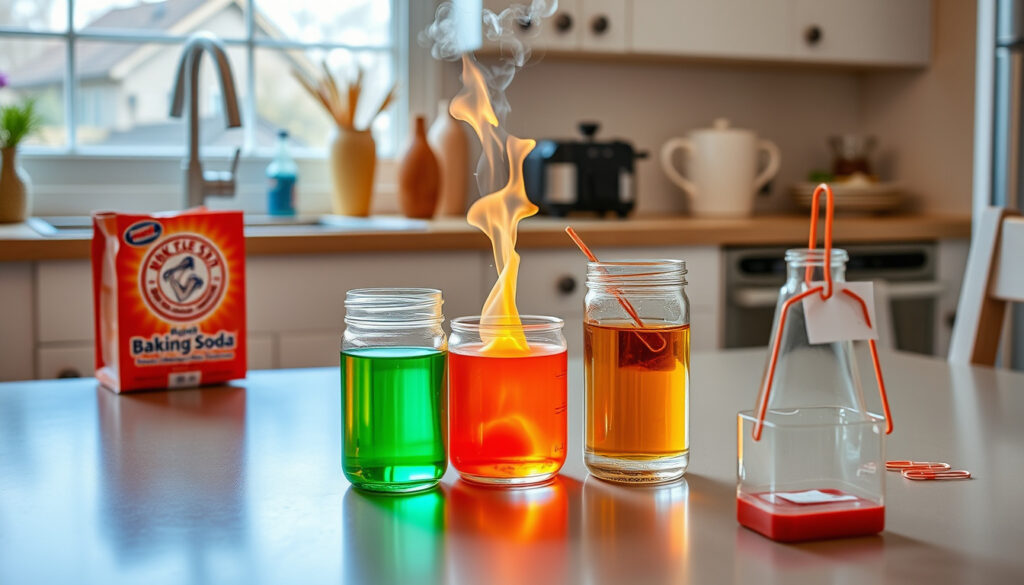
Easy Science Experiments for Kids: Fun at-Home STEM Ideas
Exploring science at home opens up a world of curiosity for children of all ages. From the moment a child watches pepper scatter across water or sees colors swirl in milk, the foundations of chemistry, physics, and material science take hold in ways textbooks rarely achieve. Simple science experiments using everyday household items provide hands-on learning opportunities that are safe, engaging, and accessible for families everywhere.
Whether you are a parent looking for a rainy-afternoon activity, a teacher planning a classroom demonstration, or a caregiver searching for educational entertainment, these experiments deliver results with minimal preparation and maximum wonder. The best part? Most require nothing more than what already sits in kitchen cabinets or bathroom drawers.
This guide covers dozens of age-appropriate experiments spanning chemistry reactions, physics demonstrations, sensory activities, and engineering projects. Each entry includes the materials needed, estimated time, and the specific STEM concept being explored, making it easy to match activities to a child’s developmental level and interests.
What Are Easy Science Experiments for Kids at Home?
The most approachable experiments for home use rely on common ingredients found in nearly every household. Water, food coloring, baking soda, vinegar, dish soap, milk, and eggshells form the backbone of countless demonstrations that teach real scientific principles without requiring specialized equipment or hazardous materials.
Overview by Category
Pepper and Soap, Magic Milk, Lava Lamp, Dancing Raisins
Baking Soda Volcano, Potato Battery, Floating Egg, Growing Crystals
Leakproof Bag, Star Projector, Simple Compass, Eggshell Chalk
Elephant Toothpaste, Rainbow in a Jar, Skittles Rainbow, Rain Cloud in a Jar
Key Insights
- Household items like baking soda, vinegar, and dish soap introduce chemistry concepts through safe, visible reactions.
- Experiments involving density, such as the floating egg or rainbow in a jar, provide concrete visual evidence of abstract physics principles.
- Sensory activities like Oobleck and slime help younger children understand material science through touch and observation.
- Engineering projects such as the potato battery bridge the gap between chemistry and physics by demonstrating energy conversion.
- Supervision remains essential for all experiments involving toddlers or very young children to prevent accidental ingestion.
- Science fair projects benefit from adding a hypothesis and tracking observations over multiple trials, as noted by educators at We Are Teachers.
- Carrying out reactions over trays or waterproof surfaces eliminates mess and allows for quick transitions between activities.
Top Experiments Snapshot
| Experiment | Age Group | Materials Needed | Time | Skills Learned |
|---|---|---|---|---|
| Pepper and Soap | Preschool to Elementary | Bowl, water, pepper, dish soap | 5 minutes | Surface tension |
| Magic Milk | Toddlers to Elementary | Milk, food coloring, dish soap, cotton swab | 10 minutes | Chemical reactions, fat molecules |
| Baking Soda Volcano | Kindergarten to Middle School | Baking soda, vinegar, food coloring, bottle | 15 minutes | Gas production, chemical reactions |
| Floating Egg | Elementary | Glass, water, salt, egg | 20 minutes | Density, solubility |
| Potato Battery | Upper Elementary | Potato, copper coin, zinc nail, wire, LED | 30 minutes | Electrical energy, circuits |
Safe and Fun Science Experiments by Age Group
Selecting experiments that match a child’s age and developmental stage ensures both safety and engagement. Activities that challenge but do not frustrate keep young scientists coming back for more, while those designed for older children introduce greater complexity and deeper conceptual understanding.
Experiments for Toddlers and Preschoolers
The youngest learners benefit most from experiments that involve their senses and require almost no setup. Simple activities with immediate, dramatic results capture attention and introduce basic cause-and-effect reasoning.
Pepper and soap offers one of the quickest demonstrations available. Sprinkling pepper onto a bowl of water and touching the surface with a soapy finger causes the pepper to scatter outward, illustrating surface tension in a way toddlers can see and react to with excitement.
Magic milk works similarly well for this age group. Adding drops of food coloring to a dish of whole milk and touching the surface with a dish-soap-coated cotton swab creates a swirling burst of color as the soap reacts with fat molecules in the milk, according to guidance from Kindred Nurseries.
The lava lamp experiment provides visual fascination with almost no mess. Filling a clear bottle with oil, adding water, and dropping in an Alka-Seltzer tablet creates rising and falling colored bubbles that mimic a real lava lamp, as described by Little Bins for Little Hands.
Experiments for Kindergarten Through Early Elementary
Children in kindergarten through approximately age seven can handle slightly more complex setups and begin to grasp underlying principles when guided by an adult. These experiments introduce basic chemistry and physics while remaining firmly within the safe, household-materials category.
The Skittles rainbow demonstrates diffusion by arranging candy pieces in a circle on a plate and adding warm water to the center. Colors spread outward and mix, creating patterns that fascinate young observers, as documented by We Are Teachers.
Growing crystals introduces patience and observation over time. Suspending a string in warm salt water allows crystals to form as the water cools and evaporates over several days, providing ongoing engagement beyond a single session.
Experiments for Older Elementary and Tweens
Children aged eight to twelve can tackle experiments requiring multiple steps, extended observation periods, and more abstract thinking. These activities often connect to school curriculum concepts in meaningful ways.
Elephant toothpaste demonstrates rapid decomposition when yeast catalyzes hydrogen peroxide into water and oxygen gas, producing dramatic foam. This experiment requires adult supervision due to the chemical involved but delivers spectacular results that reinforce lessons on chemical reactions.
The potato battery shows how chemical energy converts to electrical energy. Inserting a copper coin and zinc nail into a potato and connecting them with wire powers a small LED light, directly applying concepts of circuits and energy transfer.
Toddlers and preschoolers require constant visual supervision during all experiments. Keep all materials out of reach until actively used, and conduct any reactions over trays or covered surfaces to contain spills.
Best Science Fair Projects and Quick Activities for Kids
Science fair projects benefit from structured investigation rather than simple demonstration. Adding a hypothesis, controlling variables, and recording observations transforms a fun activity into a genuine scientific inquiry that judges and educators value.
Chemistry Experiments With Quick Reactions and Minimal Mess
Chemistry provides some of the most visually dramatic and immediately satisfying experiments, making it a popular category for both home activities and school science fairs.
The baking soda and vinegar reaction serves as a foundational chemistry experiment that scales easily from simple fizzing in a cup to a full “volcano” with food coloring added for visual impact. Connecting a balloon to the mouth of a bottle containing the reaction demonstrates gas production in a tangible way, according to KiwiCo.
Dancing raisins offers an accessible demonstration of carbonation and buoyancy. Dropping raisins into a clear glass of soda causes them to rise and fall repeatedly as carbon dioxide bubbles attach to and release from the raisin surfaces.
Cleaning pennies or coins with vinegar, lemon juice, or soda demonstrates how acids remove oxidation. This experiment lends itself naturally to fair projects by posing a question such as which liquid cleans coins most effectively, as recommended by Little Guide Detroit.
Physics and Density Experiments That Dazzle
Physics experiments often require little more than water, food coloring, and careful observation, making them ideal for home settings and classroom demonstrations alike.
The rainbow in a jar layers liquids of different densities—typically honey, dish soap, water, oil, and rubbing alcohol—creating a visible density column that demonstrates how substances of different weights settle relative to one another. Adding a light source highlights refraction through the layers.
Water color movement through paper towel wicks connects multiple cups of colored water using folded paper towels. Colors travel upward against gravity through capillary action over approximately an hour, providing ongoing visual engagement and a clear demonstration of adhesion and cohesion.
The rain cloud in a jar uses shaving cream as a cloud above colored water, with drops of food coloring falling through the foam to mimic precipitation and illustrate the water cycle.
Quick No-Prep Activities for Impromptu Learning
Some of the most effective learning moments happen spontaneously. A handful of experiments require fewer than five minutes of preparation and use materials that most homes already have on hand.
Baking soda balloon inflation requires only a bottle, baking soda, vinegar, and a balloon. Adding baking soda to vinegar inside the bottle and quickly stretching a balloon over the opening demonstrates gas production as the balloon inflates on its own.
The leakproof bag experiment fills a zip-top bag with water and pierces it with several pencils. The polymer chains in the plastic reseal around the pencil shafts, preventing leaks—a counterintuitive result that amazes children and adults alike.
For outdoor settings, the Mentos and soda geyser delivers spectacular results but requires open space and adult supervision due to the force of the eruption, as noted by Little Bins for Little Hands.
Transform any experiment into a science fair project by adding a hypothesis, testing one variable at a time, and documenting results with photographs or measurements. Comparing outcomes across multiple trials strengthens the project’s credibility.
How to Make Science Experiments Educational and Engaging
The educational value of any experiment depends less on the complexity of materials and more on how adults guide the experience. Asking open-ended questions, encouraging predictions, and connecting observations to real-world applications transforms a simple activity into lasting learning.
Connecting Activities to STEM Curriculum
Modern science curricula emphasize hands-on learning precisely because tactile experiences create stronger neural connections than passive reading. The National Science Teaching Association highlights the importance of inquiry-based learning where children develop questions rather than simply following instructions.
Chemistry experiments naturally align with physical science standards covering chemical reactions and properties of matter. Physics demonstrations connect to concepts of energy, force, and motion. Engineering projects, such as building a simple compass or constructing a barometer, introduce the design process and measurement skills.
Making Sensory Activities Meaningful
Sensory activities serve dual purposes: they provide rich tactile experiences for younger children while introducing material science concepts that older children can articulate scientifically.
Oobleck—a mixture of cornflour and water—behaves as both a solid and a liquid depending on how force is applied. Children can poke it quickly and feel resistance or pour it slowly and watch it flow. This non-Newtonian behavior provides a memorable introduction to material science.
Homemade butter demonstrates emulsion science by shaking cream in a jar until it separates into butter and buttermilk. The transformation is visible, edible, and connects cooking science to classroom chemistry.
Engineering Projects for Deeper Thinking
Engineering challenges move beyond observation into design, iteration, and problem-solving—skills that transfer across academic subjects and real-world situations.
A simple compass made by magnetizing a sewing needle and floating it on a cork in water demonstrates Earth’s magnetic field. The needle aligns north-south, providing tangible evidence of invisible forces.
A DIY barometer using a balloon stretched over a jar with a straw pointer tracks atmospheric pressure changes over days or weeks, connecting weather observations to scientific measurement.
Always supervise children during experiments involving small objects, hot water, or chemical reactions. Keep all materials intended for experiments separate from food preparation areas, and wash hands thoroughly after handling ingredients like baking soda, vinegar, or food coloring.
Step-by-Step: Running Three Essential Experiments
Understanding the process behind successful experiments helps adults guide children more effectively. The following three activities represent the most versatile and educational options across age groups.
The Magic Milk Experiment
- Prepare the surface: Pour whole milk into a shallow dish, filling it approximately half an inch deep.
- Add color: Squeeze drops of food coloring around the milk’s surface, using multiple colors for the best visual effect.
- Apply the catalyst: Dip a cotton swab in liquid dish soap and touch it gently to the center of the colored milk.
- Observe: Watch as colors burst outward in swirling patterns due to fat molecules reacting with the soap.
- Discuss: Ask children why they think the colors moved and what the soap might be doing to the milk.
The Floating Egg Density Test
- Set the baseline: Place a raw egg in a glass of regular tap water and observe that it sinks.
- Prepare the solution: Dissolve approximately six tablespoons of salt into a second glass of water, stirring until fully dissolved.
- Compare densities: Place an identical egg in the saltwater glass and observe that it floats.
- Test the boundary: Slowly add fresh water to the saltwater glass to find the exact density point where the egg begins to sink again.
- Record findings: Document the salt quantities and observation results for comparison.
The Potato Battery Power Test
- Prepare the electrodes: Insert a copper coin and a zinc-coated nail into a potato, spacing them approximately two inches apart.
- Connect the circuit: Attach one wire to the copper coin and another to the zinc nail using alligator clips or by wrapping the wires securely.
- Test the power: Touch the free ends of the wires to a small LED bulb and observe whether it illuminates.
- Expand the circuit: Connect multiple potatoes in series to increase voltage and power stronger lights or small motors.
- Document results: Record how many potatoes were needed and what voltage the setup produced.
What We Know for Certain and What Remains Unclear
Research into early STEM education consistently supports the value of hands-on experiments for developing scientific thinking. Organizations including the American Chemical Society and PBS Kids provide extensive collections of vetted experiments designed specifically for home use with children.
Established and Verified Information
- All experiments listed in this guide use materials recognized as safe when handled according to instructions and with appropriate adult supervision.
- Surface tension, density, chemical reactions, and capillary action are scientifically established principles demonstrated reliably by these experiments.
- Age recommendations reflect developmental appropriateness for fine motor skills, comprehension, and safety considerations.
- Setup times are approximate and assume materials are gathered in advance.
Information That Requires Individual Assessment
- Allergen considerations vary by household; ingredients like milk, food coloring, and dish soap should be evaluated for individual allergies before use.
- Results may vary based on ingredient concentrations, room temperature, and water quality, particularly in density-dependent experiments.
- Long-term educational outcomes depend heavily on how adults facilitate discussion and connect activities to broader concepts.
Why Science Experiments Matter for Childhood Development
Early exposure to scientific thinking shapes how children approach problems throughout their lives. When a toddler pours water between containers and notices it takes up the same amount of space regardless of the container’s shape, that child is already practicing hypothesis testing and conservation—the same reasoning skills that underpin advanced scientific inquiry.
Experiments also build persistence and resilience. A failed first attempt at growing crystals or a volcano that does not erupt as expected teaches children that iteration and refinement are central to discovery. These lessons transfer far beyond the kitchen table or classroom lab bench.
The National Science Teaching Association emphasizes that early positive experiences with science build confidence and reduce anxiety around STEM subjects in later schooling. Children who associate science with wonder and accessible materials rather than intimidating equipment and dangerous chemicals carry that openness forward into adolescence and adulthood.
Conversations sparked by experiments also develop language skills. Describing what happened, predicting what will happen next, and explaining why all require vocabulary and sentence structures that expand naturally through guided discussion.
“Science is not just a body of knowledge; it is a way of thinking. The earlier children begin practicing scientific thinking through hands-on experiments, the more natural it becomes as a problem-solving approach throughout their lives.”
— National Science Teaching Association
Recommended Resources and Where to Learn More
Families and educators seeking additional experiment ideas can explore resources from trusted organizations dedicated to science education for children.
The National Science Teaching Association provides standards-aligned activities reviewed by professional educators, ensuring content accuracy and pedagogical appropriateness. PBS Kids offers interactive science content designed specifically for young learners, with video demonstrations that show experiments in action.
For those interested in pursuing more advanced projects, Science Buddies offers a comprehensive database of science fair project ideas ranked by difficulty and aligned with specific scientific disciplines.
The American Chemical Society maintains educational resources covering chemistry concepts from basic household reactions to more advanced demonstrations suitable for older students exploring career paths in STEM fields.
Summary and Next Steps
Science experiments for kids at home represent one of the most accessible, affordable, and effective ways to introduce STEM concepts across all age groups. From the simple pepper-and-soap demonstration that teaches surface tension in five minutes to the potato battery that requires thirty minutes of setup and connects chemistry to electrical engineering, these activities deliver genuine educational value through hands-on engagement.
Starting with age-appropriate experiments, maintaining consistent adult supervision, and building conversation around observations transforms any afternoon into a learning opportunity. Whether the goal is a quick rainy-day activity, a curriculum-aligned classroom demonstration, or a science fair project that earns recognition, the experiments described in this guide provide a foundation that grows with a child’s abilities.
For families looking to extend learning further, exploring additional temperature conversion techniques or investigating chemical properties of common beverages opens new avenues for scientific inquiry built on everyday curiosity.
Frequently Asked Questions
What are good science experiments for kids at home?
Good home science experiments include pepper and soap for surface tension, magic milk for chemical reactions, baking soda and vinegar for gas production, and Oobleck for material science. These require only household items and take under fifteen minutes to complete safely with adult supervision.
What is the best science experiment for kids?
No single experiment fits every child, but magic milk and baking soda volcanoes consistently rank among the best because they deliver dramatic visual results, require minimal materials, and clearly demonstrate real scientific principles.
What science experiments can I do with baking soda?
Baking soda works with vinegar to create a volcano reaction, inflates balloons when combined with acid in a bottle, and can be used in homemade butter and fluffy slime recipes to demonstrate chemical reactions and material properties.
How do I make a science experiment educational?
Ask children to predict what will happen before starting, discuss observations during the experiment, and connect results to real-world examples afterward. Adding a hypothesis and recording results transforms demonstrations into genuine scientific inquiry.
What science experiments are safest for toddlers?
Safe experiments for toddlers include pepper and soap, magic milk, Oobleck, and lava lamps using oil, water, and Alka-Seltzer. Always supervise toddlers closely, keep materials away from mouths, and conduct activities over surfaces that can be wiped clean easily.
How long do crystal-growing experiments take?
Growing visible salt crystals typically takes two to seven days depending on temperature, humidity, and solution concentration. Checking progress daily and documenting changes through photographs maintains engagement throughout the waiting period.
What materials are needed for most home science experiments?
Common materials include water, food coloring, baking soda, vinegar, dish soap, milk, eggshells, salt, paper towels, clear glasses or jars, and spoons. Most households already have these items, making experiment preparation quick and cost-effective.
Can science experiments be used for school science fairs?
Yes. Adding a hypothesis, testing variables systematically, and recording observations converts any household experiment into a science fair project. Projects that compare outcomes—such as testing which liquid cleans pennies most effectively—demonstrate scientific methodology effectively.
Related stories



Hannah Walsh is Municipal Affairs Editor at Toronto Post, covering city hall, councils, transit and urban policy across the GTA.