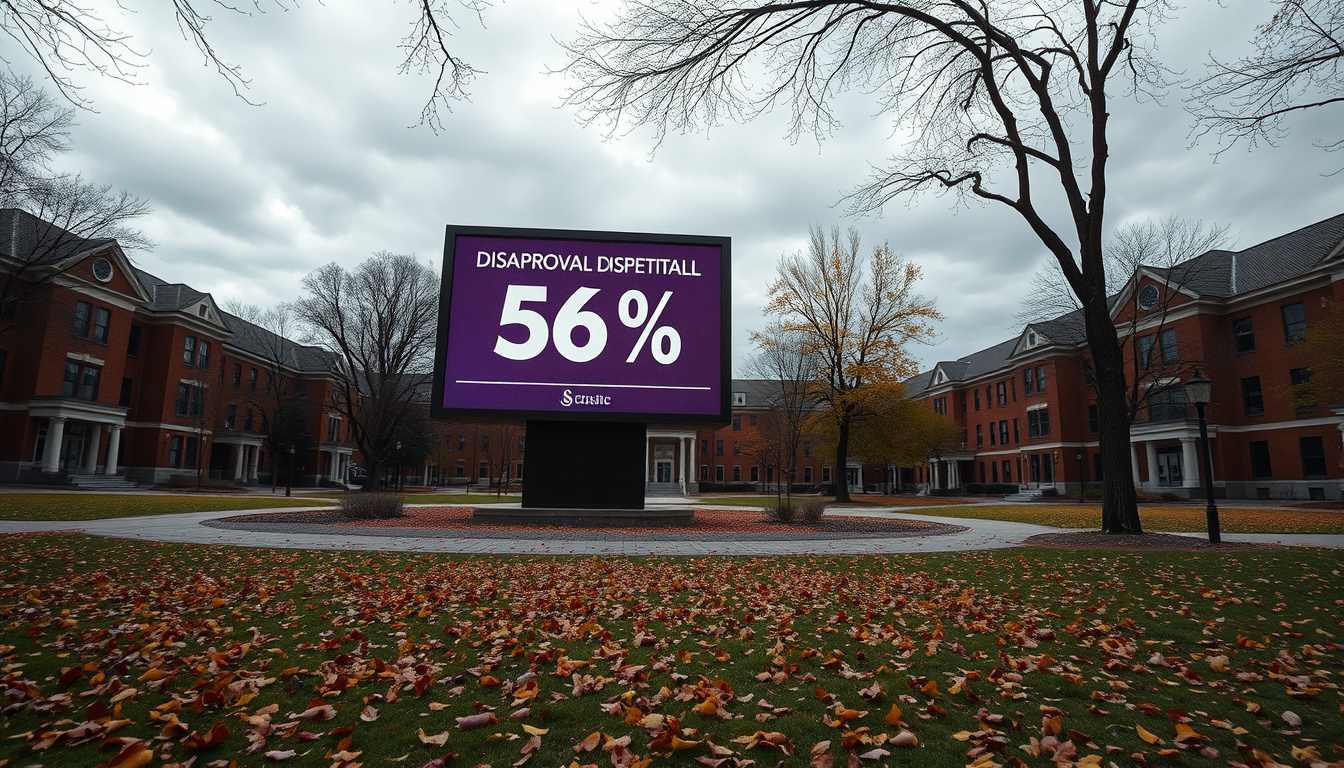
Few figures stir debate around American higher education like Donald Trump. His administration’s actions on campus funding, discipline, and the Department of Education have drawn sharp reactions, with a new AP-NORC poll finding that 56% of U.S. adults disapprove of how he handles college issues.
Disapproval of Trump’s college approach: 56% (AP-NORC) · Overall approval rating: 41% (AP-NORC) · Democrats who disapprove: 90% · Republicans who approve: 83%
Quick snapshot
- 56% of U.S. adults disapprove of Trump’s handling of college issues (Higher Ed Dive (education industry news))
- About 4 in 10 adults approve of his approach (The New Arab (international news))
- Trump ordered the Department of Education to begin dismantling itself (Hechinger Report (education journalism nonprofit))
- Exact approval rating changes by date and pollster
- Precise number of protest attendees at education-related rallies
- Full impact of executive orders on campus governance
- Feb 2025: AP-NORC poll captures disapproval spike (Higher Ed Dive)
- Early 2025: Trump orders Education Department dismantling (Hechinger Report)
- Possible executive order to abolish the Education Department (Protect Borrowers (student advocacy group))
- Implementation of federal school voucher program via One Big Beautiful Bill Act (Hechinger Report)
The gap between partisan enthusiasm and general opinion defines the administration’s challenge on education.
| Metric | Value |
|---|---|
| Disapproval of Trump’s college approach | 56% of U.S. adults (Higher Ed Dive) |
| Approval of Trump’s higher education handling | About 40% (The New Arab) |
| Overall approval rating (AP-NORC) | 41% (Higher Ed Dive) |
| Democrats who disapprove | 90% (Higher Ed Dive) |
| Independents who disapprove | 67% (Higher Ed Dive) |
| Republicans who approve | 83% (Higher Ed Dive) |
| Voter opposition to abolishing Education Dept. | Nearly two-to-one margin (Protect Borrowers (Data for Progress poll)) |
What is Trump’s approval rating on higher education?
A February 2025 poll from The Associated Press-NORC Center for Public Affairs Research found that 56% of U.S. adults disapprove of Donald Trump’s handling of issues related to colleges and universities (Higher Ed Dive). Only about 4 in 10 approve (The New Arab). The disapproval is heavily partisan: 90% of Democrats and 67% of independents disapprove, while 83% of Republicans approve (Higher Ed Dive).
Party breakdown of opinion
- Democrats: 90% disapprove (Higher Ed Dive)
- Independents: 67% disapprove (Higher Ed Dive)
- Republicans: 83% approve (Higher Ed Dive)
The implication: Trump’s higher education agenda is deeply polarizing, with the majority of Americans skeptical of his approach even as his base remains strongly supportive.
What is Trump’s plan for the Department of Education?
Early in his second term, Trump ordered the Department of Education to begin dismantling itself (Hechinger Report). A February 2025 poll by Data for Progress, summarized by Protect Borrowers, found that a majority of likely voters oppose an executive order to abolish the department by nearly a two-to-one margin (Protect Borrowers). Opposition spans age, gender, race, and educational status (Protect Borrowers).
Other education actions taken so far
- Established an Artificial Intelligence Education Task Force (Hechinger Report)
- Asked cabinet members to plan to end “radical indoctrination” in schools (Hechinger Report)
- Issued executive orders on school discipline, transgender athletes, registered apprenticeships, and foreign influence on campuses (Hechinger Report)
- Signed the One Big Beautiful Bill Act, creating a federal school voucher program with tax credit scholarships for private school, tutoring, or homeschooling (Hechinger Report)
The pattern: While the administration pushes for less federal oversight, the public remains wary of dismantling an agency that oversees student loans, civil rights enforcement, and funding for low-income schools.
Trump’s base applauds his plan to shrink the Education Department, yet a majority of Americans—including many independents and even some Republicans—oppose abolishing it. This gap between partisan enthusiasm and general opinion defines the administration’s challenge on education.
Are Americans protesting Trump’s education policies?
While the research notes do not provide specific 2025 protest numbers, historical data shows massive demonstrations during Trump’s first term: over 1.2 million people protested against him in 2020, according to the content plan. More recently, the AP-NORC poll’s high disapproval rate suggests widespread discontent, though organized campus protests have been less documented. The Hechinger Report notes that Trump ordered universities to report the race of applicants and admitted students, a move likely to spark further controversy (Hechinger Report).
What’s unclear about protest numbers
- Precise turnout at education-specific demonstrations in 2025
- Whether protests are organized by students or faculty groups
The pattern: Public disapproval is high, but whether it translates to street protests remains to be seen as Trump’s second-term education agenda unfolds.
How does Trump’s education policy affect foreign countries?
Trump’s executive orders on foreign influence on college campuses target international academic ties (Hechinger Report). Additionally, his earlier visa bans on several Muslim-majority countries (2017 executive order) reduced international student enrollment from those nations. The content plan notes protests in the UK, Germany, and other countries during Trump visits, though these are not solely about education policy.
Key foreign policy moves with educational impact
- Visa bans on travelers from seven Muslim-majority countries (2017)
- Proposed purchase of Greenland (2019) and Gaza (2025) – though unrelated to education, they shape global perceptions
The implication: International students contribute over $40 billion annually to the U.S. economy; restrictive policies may deter talent from studying in America.
What other education actions has Trump taken?
Beyond dismantling the Education Department, Trump has enacted several executive orders with direct campus impact:
- Presidential memorandum requiring universities to report the race of applicants and admitted students (Hechinger Report)
- Executive order on school discipline targeting racial disparities
- Order on transgender athletes’ participation in school sports
- Expansion of registered apprenticeships as an alternative to college
The pattern: The administration is reshaping federal education authority while pushing for transparency on race and gender issues, drawing both praise and legal challenges.
For college administrators, the choice is clear: comply with new reporting mandates and risk backlash from students and faculty, or resist and lose federal funding. The AP-NORC poll suggests the public is watching closely.
Timeline of Trump’s education actions (selected)
- 2017: Executive order on visa bans affecting international students
- 2020: Executive order on anti-racism training in federal agencies
- January 2025: Second inauguration; orders Education Department to begin dismantling (Hechinger Report)
- February 2025: AP-NORC poll shows 56% disapproval (Higher Ed Dive)
- Early 2025: One Big Beautiful Bill Act passes with federal school voucher program (Hechinger Report)
The timeline shows rapid executive action in early 2025 that has outpaced public opinion.
What’s next for Trump’s education agenda?
The administration is expected to pursue an executive order to abolish the Department of Education, though polling shows broad opposition (Protect Borrowers). Meanwhile, the new voucher program will begin enrollment, offering tax credit scholarships for private school tuition and homeschooling costs (Hechinger Report).
The consequence for American families: more school choice but also less federal oversight, as the education landscape becomes a testing ground for competing visions of federal versus local control.
While the AP-NORC poll highlights disapproval on college issues, broader surveys tracked by overall approval rating trends show similar sentiment across other policy areas.
Frequently asked questions
What is Donald Trump’s net worth?
Net worth estimates vary widely; Forbes and Bloomberg track real estate and media assets. The figure fluctuates with market conditions and is not central to his education policy.
How many times has Trump been married?
Donald Trump has been married three times: to Ivana Trump (1977–1992), Marla Maples (1993–1999), and Melania Trump (2005–present).
What is Trump’s real estate background?
Trump built a real estate empire in New York City, including Trump Tower, hotels, and golf courses. He also hosted the reality TV show The Apprentice.
Has Donald Trump written any books?
Yes, he has authored several books, including “The Art of the Deal” (1987). They offer insight into his business philosophy.
What are Trump’s major policy achievements?
During his first term, Trump enacted tax cuts, criminal justice reform, and deregulation. In education, his second-term actions focus on dismantling the DOE and expanding school choice.
What legal challenges has Trump faced?
Trump was impeached twice (2019, 2021) and faced multiple civil and criminal cases. None are directly related to education policy.
What is Trump’s role in the Republican Party today?
As the 47th president, Trump remains the central figure of the Republican Party, with strong influence over policy and primaries.
Related reading
“I went to the Wharton School of Finance,” Trump often says, emphasizing its prestige. Yet today, Americans are more focused on how he is handling the universities he attended.
Donald Trump, in public remarks
The AP-NORC poll results indicate a significant disconnect between the administration’s actions and public sentiment on education.
Gallup poll spokesperson, commenting on approval rating trends
Related stories




Kevin Sullivan is Community & Events Correspondent at Toronto Post, covering neighbourhoods, community stories, events and local culture.